About Aratinga wagleri frontata (Cabanis, 1846)
Taxonomy and Naming
The scarlet-fronted parakeet, whose scientific name is Aratinga wagleri frontata (Cabanis, 1846), is 34 to 40 cm (13 to 16 in) long and weighs 162 to 217 g (5.7 to 7.7 oz).
Sexual Dimorphism
Males and females have identical appearance.
Adult Plumage
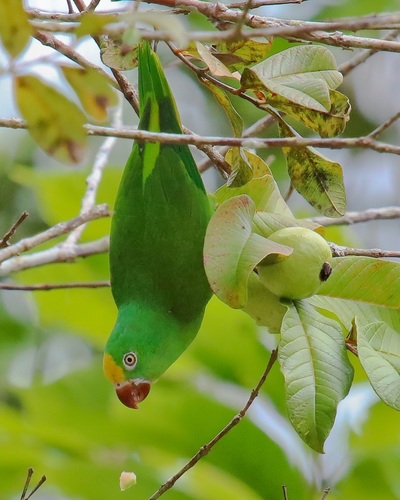
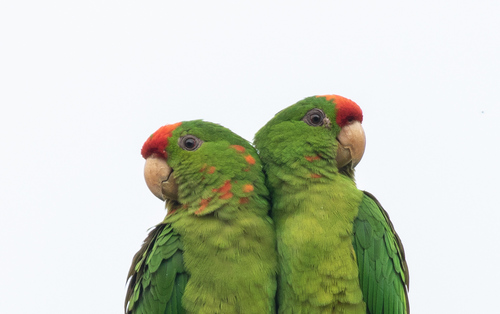
Adults are mostly green, with a yellower tone on their underparts; some individuals have red speckles on the throat. The species' common English name comes from the red coloring on its forehead and the front portion of its crown. The undersides of its flight feathers and tail are olive-yellow.
Soft Part Coloration
Its iris is pale gray, surrounded by bare gray skin; its bill is horn colored, and its legs and feet are brownish.
Subspecies Physical Traits
The subspecies P. w. transilis is overall somewhat smaller and darker than the nominate subspecies, and the red marking on its crown does not extend as far toward the back of the head.
Immature Plumage
Immature birds look similar to adults, but have less red coloring on their heads.
Distribution Pattern
The scarlet-fronted parakeet has a discontinuous distribution.
Nominate Subspecies Range
The nominate subspecies occurs in the Colombian Andes, the isolated Sierra Nevada de Santa Marta in northern Colombia, the Serranía del Perijá along the Colombia-Venezuela border, and western Venezuela.
Transilis Subspecies Range
Subspecies P. w. transilis occurs in extreme eastern Colombia and northern Venezuela, ranging from Falcón east to Sucre and Monagas.
Habitat Types
This species lives in a variety of landscapes including cloudforest edges, tropical deciduous forest, gallery forest, and secondary forest. It is also found in cultivated fields, orchards, and parks in built-up areas.
Elevation Range
It occurs at elevations between 350 and 2,500 m (1,100 to 8,200 ft).