About Aquilegia alpina L.
Taxonomic Identity and Growth Form
Aquilegia alpina L. is a perennial herb that reaches 15 cm (5.9 in) to 60 cm (24 in) in height.
Leaf Arrangement
Its leaves are biternate and arranged in a basal growth pattern, emerging from the base of the stem.
Stem Hair Characteristics
The lower sections of the stems are covered in soft hairs (pilose), while the upper stem sections are densely covered in fine hairs (pubescent).
Leaflet Dimensions and Structure
The middle leaflets are 22 mm (0.87 in) to 28 mm (1.1 in) long and 24 mm (0.94 in) to 34 mm (1.3 in) wide, and each leaflet has its own small stalk (petioluled).
Flower Count Per Stem
Each stem of Aquilegia alpina produces 1 to 3 flowers, occasionally up to 5 flowers per stem.
Flower Orientation
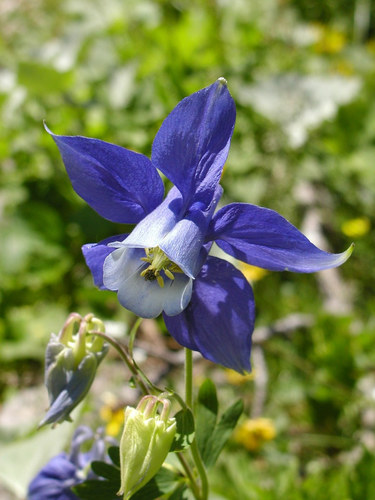
All flowers are nodding.
Flower Color and Size
Their color ranges from bright light blue to blue-purple, and they measure 6–9 cm (2.4–3.5 in) across.
Nectar Spur Shape
The nectar spurs located at the tip of the flower are straight or only slightly curved.
Nectar Spur Length
Among Eurasian Aquilegia species, Aquilegia alpina has the longest nectar spurs, which measure 21.5 mm (0.85 in).
Sepal Shape and Size
The plant's spreading sepals vary in shape from lance-ovate to wider, and measure 3 cm (1.2 in) to 4.5 cm (1.8 in) long.
Ornamental Reputation
This species' flowers are widely regarded as unusually beautiful.
Philip A. Munz Floral Assessment
Robert Nold recounted that American botanist Philip A. Munz was almost completely overcome when he described Aquilegia alpina as "one of the most beautiful of all the Aquilegias".
Reginald Farrer Floral Assessment
British botanist Reginald Farrer held a similarly positive opinion of the flower's appearance.
Native Range
This species is native to the subalpine regions of France, Switzerland, Austria, and Italy.
Habitat and Altitude Range
It grows at altitudes between 1,300–1,900 m (4,300–6,200 ft), most often in rocky areas and stony pastures over carbonate bedrock.
Regional Population Density
It is rare in the subalpine meadows of southwestern Switzerland, Austria, and northwestern Italy, but is more common in the Maritime Alps of France.
Blooming Period and Pollinator
Aquilegia alpina blooms from July to September, and is pollinated by bees.
Cultivated Hybrid Pollination Observation
Cultivated hybrids of A. alpina with hooked nectar spurs grown in the United States have been observed being foraged by the moth species Hemaris thysbe.
Cultivation History
Aquilegia alpina has a long history of cultivation, and was commonly available for purchase by 1946.
Cultivar Mislabeling Prevalence
Most plants sold under the name A. alpina are actually crosses between multiple Aquilegia species, a common issue across the genus that developed over hundreds of years of cultivation.
Aquilegia vulgaris Hybrid Ancestry
By 1946, Munz noted that most plants labeled as "A. alpina" were generally hybrids that incorporated Aquilegia vulgaris.
Hybrid Identification Trait
This ancestry can be identified by the hooked nectar spurs these cultivated plants typically have.
Aquilegia bertolonii Mislabeling
Other plants sold as A. alpina were actually the species Aquilegia bertolonii.
2003 Mislabeling Confirmation
Nold confirmed that Munz's observations were still accurate in 2003.