About Pelodiscus sinensis Wiegmann, 1835
Common Name & Sexual Size Dimorphism
Pelodiscus sinensis, commonly known as the Chinese softshell turtle, shows sexual size dimorphism: females can reach a maximum straight-line carapace length of 33 cm (13 in), while males are smaller at up to 27 cm (11 in), and have longer tails than females.
Sexual Maturity
Sexual maturity is reached when the turtle's carapace measures 18–19 cm (7.1–7.5) in length, which occurs between 4 and 6 years of age.
Limb Adaptation
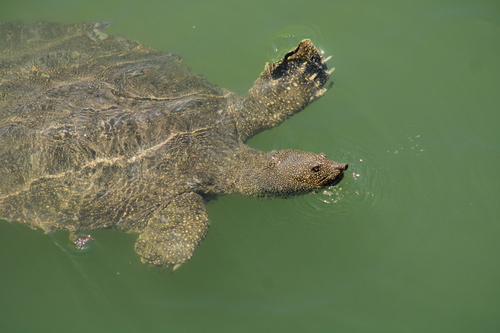
It has webbed feet adapted for swimming.
Softshell Carapace Characteristics
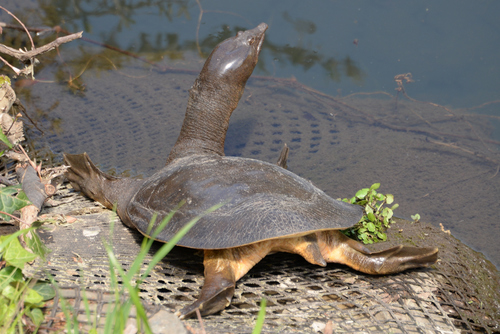
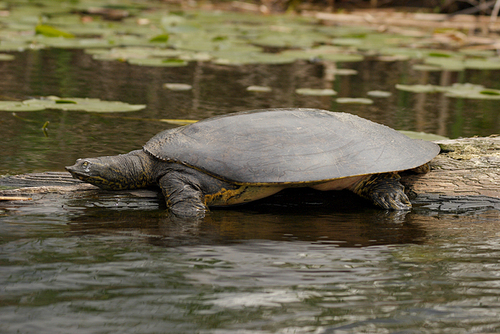
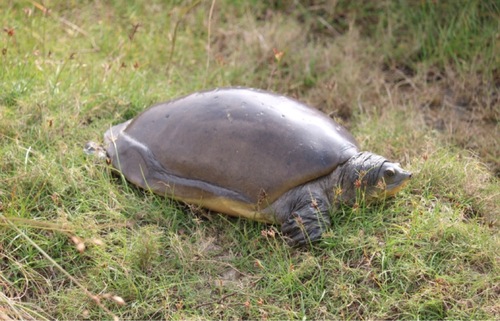
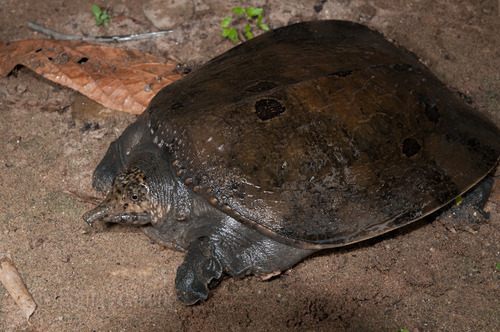
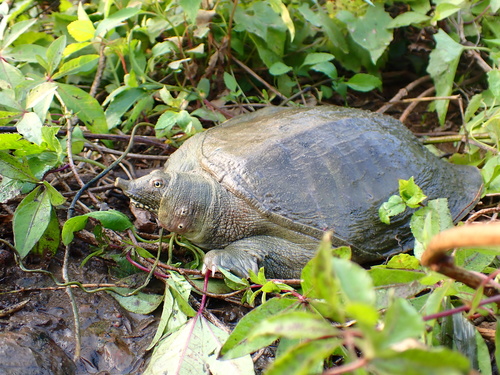
It gets the "softshell" name because its carapace does not have horny scutes (scales). Instead, the carapace is leathery and pliable, especially along the sides. Like other turtles, it has a layer of solid bone beneath the central part of the carapace, but this bone layer is absent from the outer edges of the carapace.
Shell Functional Benefit
The light, flexible shell lets this turtle move more easily both in open water and on muddy lake bottoms.
Carapace Coloration
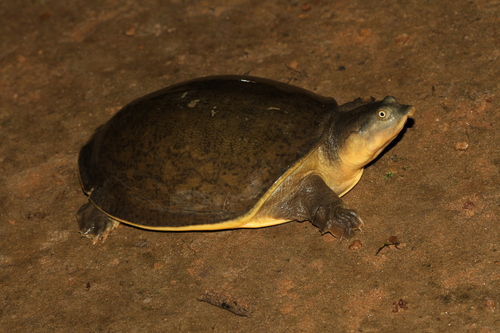
The carapace of P. sinensis is olive-colored and may have dark blotches.
Plastron Coloration
Its plastron is orange-red, and may also have large dark blotches.
Limb Coloration
The limbs and head are olive on the dorsal side; the forelimbs are lighter, while the hind limbs are orange-red on the ventral side.
Head & Throat Markings
The head has dark flecks, with dark lines that radiate out from the eyes. The throat is mottled, and there may be small, dark bars on the lips.
Tail & Thigh Markings
There is a pair of dark blotches in front of the tail, along with a black band on the posterior side of each thigh.
Native Range in China & Taiwan
The Chinese softshell turtle is native to Taiwan and China, where it occurs in Anhui, Fujian, Gansu, Guangdong, Guangxi, Guizhou, Hebei, Henan, Hong Kong, Hubei, Hunan, Inner Mongolia (Nei Mongol), Jiangsu, Jiangxi, Shaanxi, Shandong, Shanxi, Sichuan, Yunnan, and Zhejiang Provinces.
Taxonomic Split of Former Conspecific Populations
Populations that were originally included in this species from Northeast China, Russia, Korea, and Japan are now classified as a separate species, the Amur softshell turtle (P. maackii). Populations from Vietnam and Hainan Island are now recognized as the spotted softshell turtle (P. variegatus). Additionally, localized populations in Guangxi, Hunan, and Anhui (where the Chinese softshell turtle also occurs) are now recognized as separate species: the lesser Chinese softshell turtle (P. parviformis), the Hunan softshell turtle (P. axenaria), and the Huangshan softshell turtle (P. huangshanensis).
Difficulty Defining Native Range
It is hard to determine the exact native range of the Chinese softshell turtle, because it has a long history of use as food and herbal medicine, and has been spread by migrating human populations.
Introduced Populations Overview
Outside its native range in China, escaped individuals have been recorded in many countries, and some of these populations have become established as introduced populations.
Non-native Range in Asia
Non-native locations in Asia include: the Bonin Islands, Honshu, Kyushu, Ryukyu Archipelago, and Shikoku in Japan; South Korea; Laos; Vietnam; Thailand; Singapore; Bohol, Cebu, Leyte, Luzon, Mindanao, Mindoro, and Panay in the Philippines; East and Peninsular Malaysia; Kalimantan, Sumatra, and West Timor in Indonesia; East Timor; and Iran.
Non-native Range Outside Asia
Outside Asia, recorded non-native locations include Pará in Brazil; Spain; and Guam, the Northern Mariana Islands, and Oahu (Hawaii) in the United States.
Invasive Species Impact
In areas where it is not native, the Chinese softshell turtle is an invasive pest that endangers various native species and disrupts many ecosystems.
2024 Massachusetts Sighting
In 2024, this species was found in the Merrimack River in Massachusetts.
Habitat Type
The Chinese softshell turtle inhabits fresh and brackish water.
Specific Habitat Locations
In China, it is found in slow-current rivers, lakes, ponds, canals, and creeks; in Hawaii, it can be found in marshes and drainage ditches.
Mating Behavior
During mating, which takes place either at the water surface or underwater, a male will hold the female's carapace with his forelimbs, and may bite her head, neck, and limbs.
Sperm Retention
Females can retain sperm for nearly a year after copulation.
Clutch Characteristics
Females lay clutches of 8 to 30 eggs, and may lay 2 to 5 clutches per year. Eggs are laid in a nest with an entrance around 76–102 mm (3–4 in) across.
Egg Physical Traits
The eggs are spherical, with an average diameter of about 20 mm (0.79 in).
Incubation Period
Eggs hatch after an incubation period of roughly 60 days; the incubation time can be longer or shorter depending on temperature.
Hatchling Size
Average hatchlings have a carapace length and width both of about 25 mm (1 in).
Hatchling Sex Determination
The sex of Chinese softshell turtle hatchlings is not determined by incubation temperature.