About Anthracoceros coronatus (Boddaert, 1783)
Scientific Name and Size
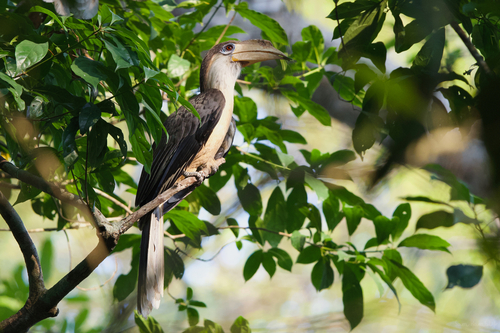
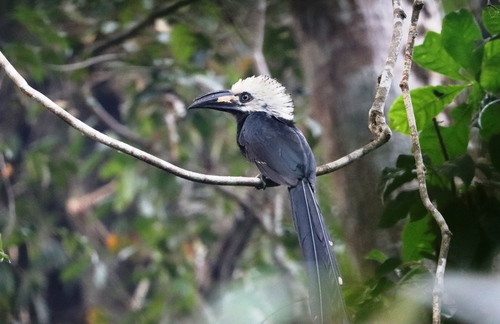
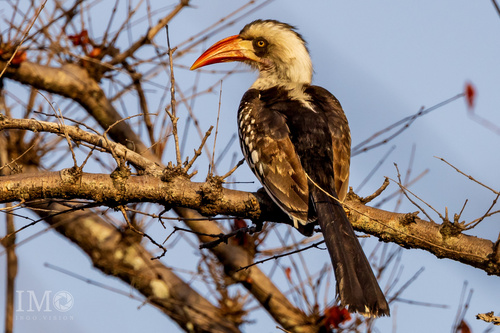
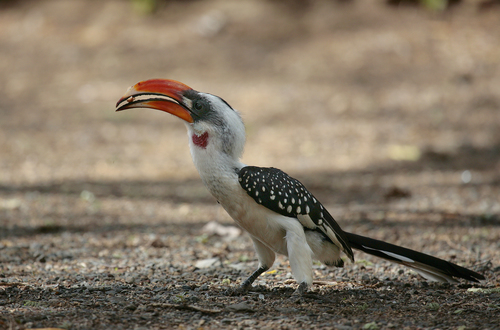
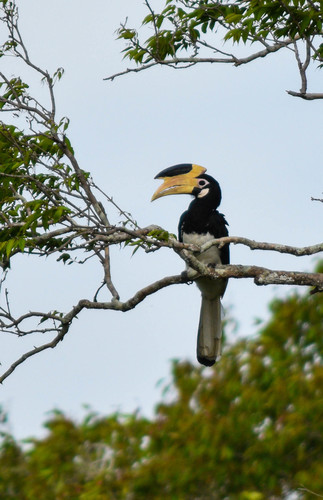
The Malabar pied hornbill (scientific name Anthracoceros coronatus (Boddaert, 1783)) is a large hornbill species that reaches 65 cm (26 in) in length and weighs around 1 kg (2.2 pounds).
Plumage Coloration
It has mostly black plumage, with contrasting white markings on its belly, throat patch, tail sides, and the trailing edge of its wings.
Bill and Casque
Its bill is yellow, with a large, primarily black casque.
Sexual and Juvenile Differences
Females have white orbital skin that males do not have, and juvenile Malabar pied hornbills do not have a casque.
Similar Species
This species can be easily confused with the oriental pied hornbill.
Breeding Range
The Malabar pied hornbill is a common resident breeding species in India and Sri Lanka.
General Habitat
It inhabits evergreen and moist deciduous forests, and is often found near human settlements.
Distribution Regions
It is distributed across three main regions in the Indian subcontinent: Central and Eastern India, the Western Ghats, and Sri Lanka.
Central and Eastern India Range
In Central and Eastern India, its range extends from western West Bengal through parts of Jharkhand, Chhattisgarh, Odisha, Madhya Pradesh, northern and eastern Maharashtra, northern Andhra Pradesh, and the northeast tip of Telangana.
Western Ghats Range
Along the Western Ghats, the species occurs in scattered populations along the eastern slopes, the Konkan belt, and the west coast, ranging from western Maharashtra through Goa, western Karnataka, Tamil Nadu, and Kerala.
Sri Lanka Habitat
In Sri Lanka, the species lives mainly in low country and dry zone forests, as well as in home gardens.
Diet Composition
This species is omnivorous, feeding on fruits, small mammals, birds, small reptiles, and insects, among other items.
Feeding Behavior
Prey is killed and swallowed whole.
Non-Breeding Season Diet
Figs are an important food source: they make up 60% of the species' diet from May to February, which is the non-breeding season.
Breeding Season Diet
During the breeding season in March and April, up to 75% of the fruits delivered to nests are figs.
Toxic Fruit Consumption
Malabar pied hornbills also feed on other fruits, including the fruits of Strychnos nux-vomica, which are toxic to many vertebrates.
Kaiga Power Station Sightings
Great pied hornbills and Malabar pied hornbills are frequently sighted at the township of India's Kaiga Atomic Power Station near Karwar.
Kaiga Forest Habitat
The high biodiversity of the forest surrounding the station provides a habitat for a wide variety of rare bird species.
Population Study Results
A 23-year comparison study of Malabar pied hornbill populations at Dandeli found no significant change in population numbers.
Tribal Belief
In central India, tribal peoples have traditionally believed that hanging a Malabar pied hornbill skull (called dhanchidiya) brings wealth.