About Rhyticeros cassidix (Temminck, 1823)
Common Name and Taxonomy
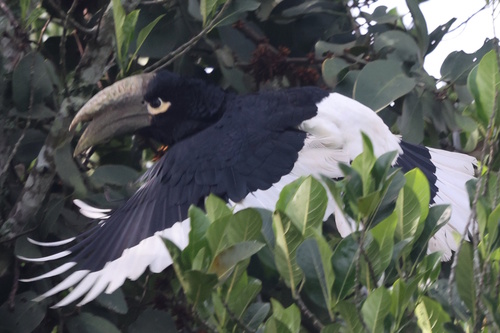
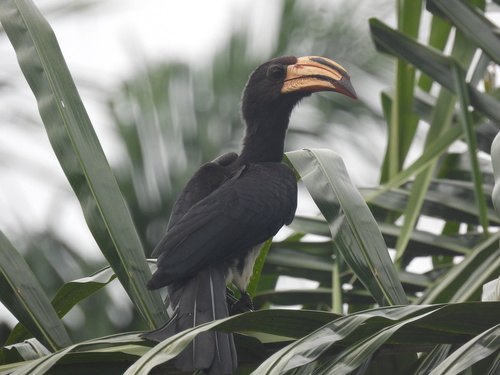
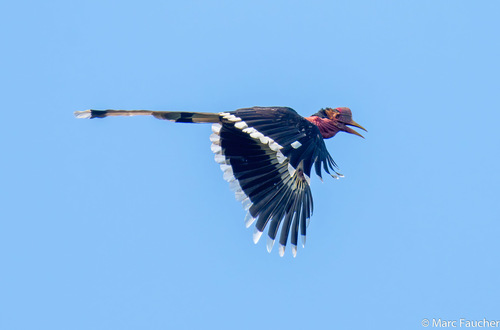
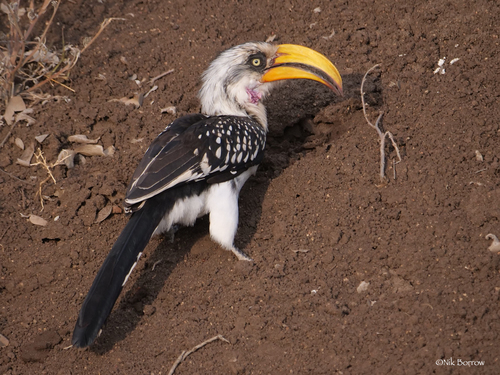
Rhyticeros cassidix, commonly called the knobbed hornbill, is a large black hornbill species.
General Morphology
It has a yellow bill, white tail feathers, pale blue skin surrounding the eye, blackish feet, and a bare dark blue throat.
Sexual Dimorphism
Males differ in appearance from females: males have a rufous to buff face and neck, orange-red eyes, and a tall red casque on the top of the bill, while females have a black face and neck, a yellow casque, and brownish eyes.
Endemic Range
This species is an Indonesian endemic, found only on Sulawesi, Buton, Lembeh, Togian, and Muna Island.
Habitat and Elevation
It lives in evergreen forest at elevations up to 1,800 m, and also forages in secondary forest, open woodland, and plantations.
Mating System
Like other hornbill species, the knobbed hornbill is thought to be monogamous.
Diet Composition
Its diet is made up mostly of fruits, but it also eats insects and small vertebrates.
Breeding Season
Its breeding season lasts 27 to 30 weeks, and it appears to be triggered by a sharp reduction in rainfall.
Egg-Laying Behavior
For egg-laying, the female seals herself inside a tree hole using her own feces.
Parental Provisioning
During this period, the male brings food to the female and their young through a narrow slit left in the seal.
Ecological Role
Knobbed hornbills act as important seed dispersers in their native habitat, and affect the initial fate of seeds from multiple tropical forest tree species.