About Anilios bituberculatus (Peters, 1863)
Common Name & General Form
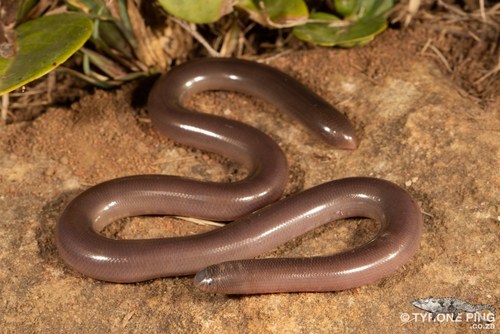
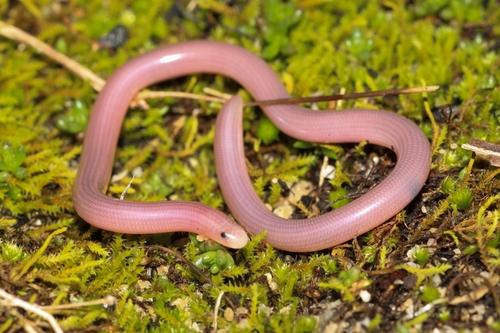
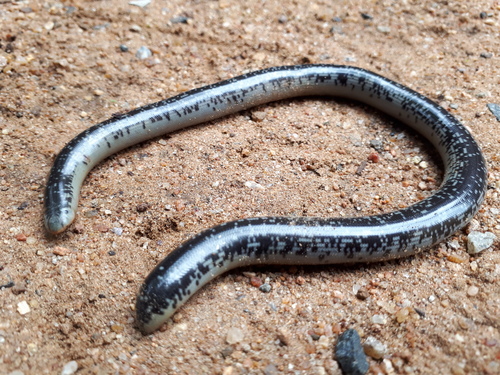
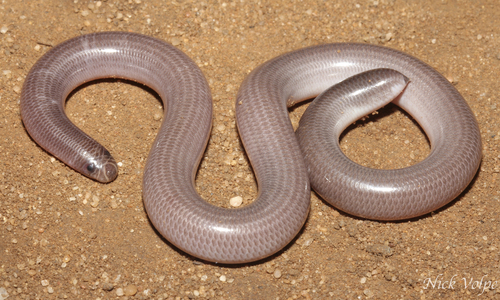
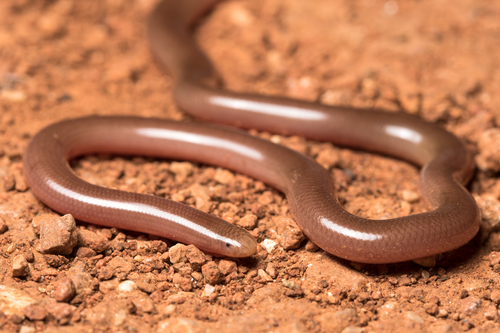
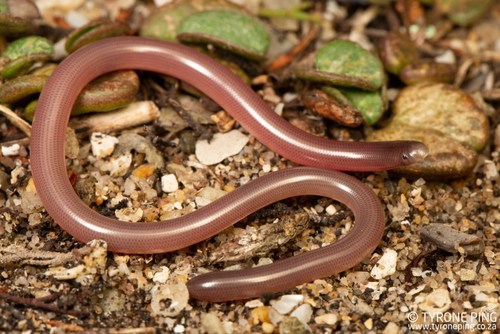
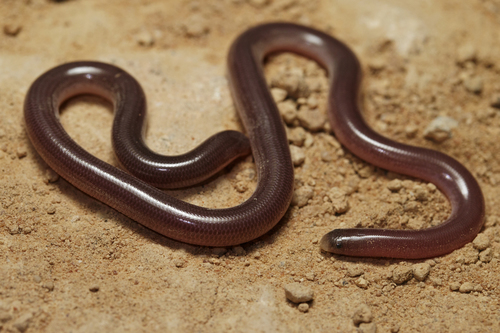
Anilios bituberculatus is a small, thin snake with shiny scales.
Size
Its average total length is around 30 cm, reaching a maximum of 45 cm.
Coloration
The dorsal side is brown to black, while the ventral side is creamy white to pinkish white.
Body Shape
Its body maintains a uniform thickness along its length, ending in a very short, conical spine.
Scale Count
This species has 20 mid-body dorsal scale rows, 414 to 485 ventral scales, and 11 to 18 sub-caudal scales.
Nasal Structure
Its nasal cleft is not visible from above; it does not divide the nasal openings and connects to the second labial scale below.
Eye Appearance
The eyes appear as small dark dots positioned under the head scales.
Mouth Structure
The small, curved mouth sits behind and below the snout tip, similar to the mouth of a shark.
Snout Morphology
When viewed from above, the snout has three lobes and an angular profile.
Distribution Documentation Status
Due to this species' cryptic behavior, its full geographic distribution is not yet completely documented.
Habitat Adaptation
It is adapted to arid conditions and occurs across a variety of habitats ranging from coastal areas to drier regions of southern Australia, extending from inland New South Wales to Western Australia.
Recorded Range
It has been recorded in the Australian states and territories of New South Wales, the Northern Territory, Queensland, South Australia, Victoria, and Western Australia.
Microhabitat
Like other blind snakes, Anilios bituberculatus is most commonly discovered when dug up from termite or ant nests.
Locomotion
It travels underground through tunnels built by these insects.
Surface Activity
Individuals may also be seen moving across the ground surface at night, particularly after rain and/or during warm weather.
Defensive Behavior
When disturbed, this snake can emit a strong, foul odor from its well-developed anal glands.
Reproductive Mode
Anilios bituberculatus, also called the prong-snouted blind snake, is oviparous.
Clutch Details
Female snakes produce clutches ranging from two to nine eggs, with an average clutch size of six eggs.
Hatchling Traits
Newly hatched young are independent and fend for themselves.
Male Reproductive Anatomy
Males possess solid eversible awned hemipenes that can retract into the tail in a helical pattern, as well as retrocloacal sacs.