About Afrotyphlops schlegelii (Bianconi, 1849)
Color Phases Overview
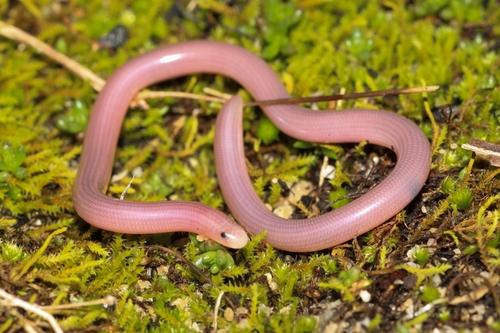
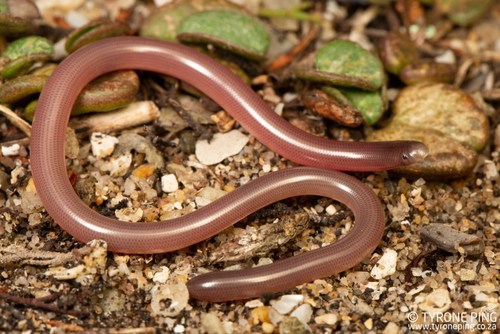
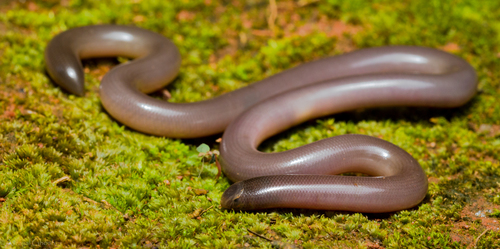
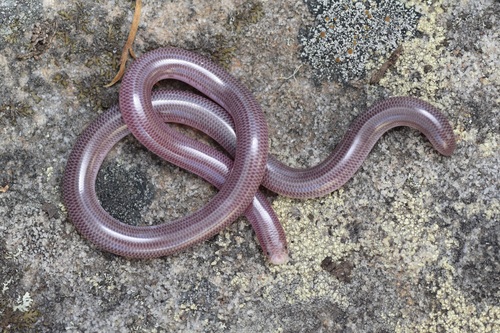
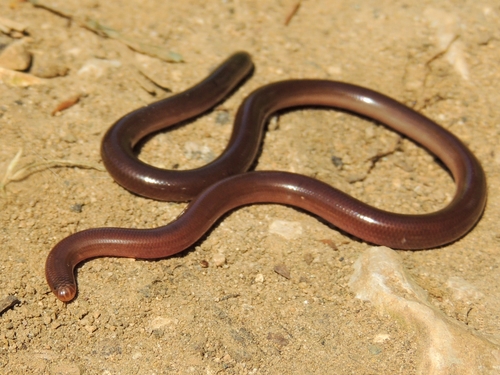
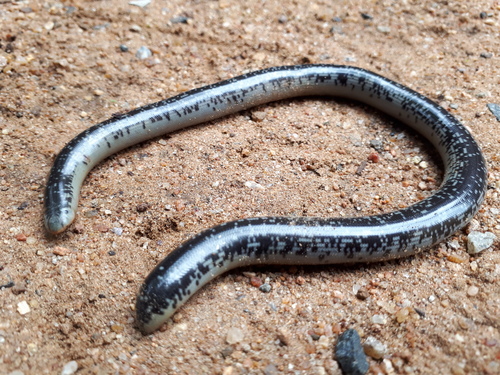
Afrotyphlops schlegelii (Bianconi, 1849) occurs in three distinct color phases: uniform, blotched, and striped.
Uniform Phase Coloration
Uniform phase individuals are black to brown on their dorsal side, and straw-colored on their ventral side.
Blotched Phase Coloration
Blotched phase individuals have irregular black to dark brown blotches on the dorsal side, with yellow-green to yellow coloring on the ventral side and sides.
Striped Phase Coloration
The striped phase forms when each scale has black edges; these black lines merge as the individual ages.
Maximum Recorded Size
The maximum recorded snout-vent length (SVL) for this species is 95 cm (37+3⁄8 in).
Body Scale Row Count
Its body scales are arranged in 30 to 44 rows around the body.
Vertebral Scale Count
The vertebral row has more than 300 scales, with a maximum count of 623.
Snout and Nostril Features
The snout is very prominent, with a sharp horizontal cutting edge, and the nostrils are located below this edge.
Rostral Scale Characteristics
The rostral scale is very large, extending as far back as the eyes. The portion of the rostral visible from below is broader than it is long.
Upper Labial Scale Count
There are four upper labial scales.
Nasal Scale Structure
The nasal scale is semidivided, with a suture extending from the first upper labial.
Preocular Scale Features
A preocular scale is present; it is narrower than the nasal or ocular scale, and is in contact with the second and third upper labials.
Eye Position
The eyes are distinct, and positioned below the suture between the preocular and ocular scales.
Body Diameter Proportion
Body diameter is 25 to 30 times smaller than total body length.
Tail Morphology
The tail is broader than it is long, and ends in a spine.
Geographic Distribution
This species is distributed across Angola, Botswana, the Democratic Republic of the Congo, Eswatini, Ethiopia, Kenya, Malawi, southern Mozambique, northern Namibia, Somalia, South Africa, southern Sudan, Tanzania, northern Uganda, Zambia, and Zimbabwe.
Habitat Range
It can be found in a variety of habitats, ranging from sandveld to coastal bush.
Reproductive Mode
A. schlegelii is oviparous.
Egg Clutch Size
A female typically lays 12 to 40 eggs, though very large individuals may lay up to 60 eggs.
Egg Details and Incubation
Eggs are laid in late spring or summer, and measure 20–22 mm long by 10–12 mm wide (3/4-7/8 inch x 3/8-7/16 inch). They hatch after 5–6 weeks.