About Afrotyphlops bibronii (Smith, 1846)
Taxonomic Identity
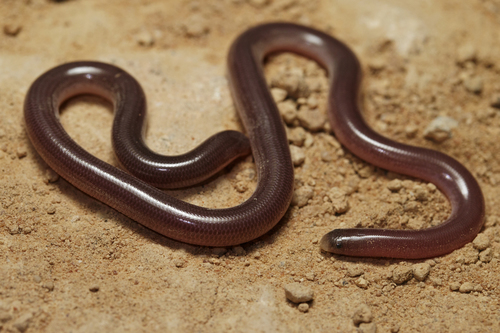
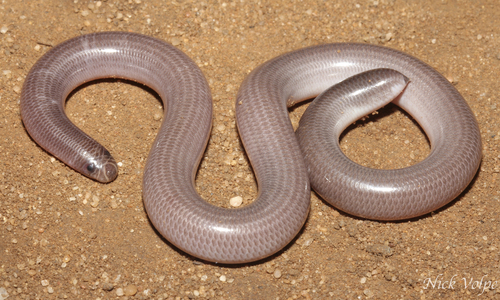
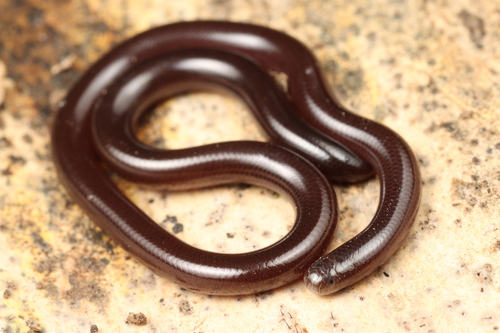
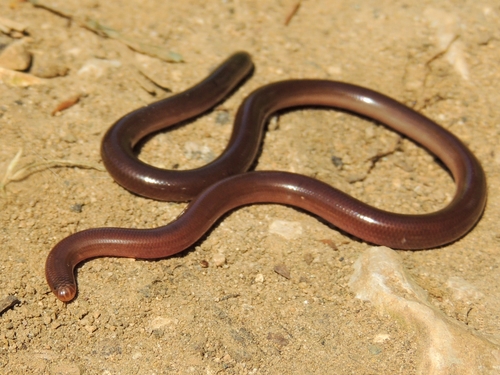
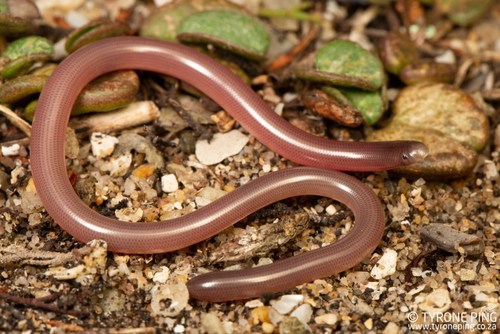
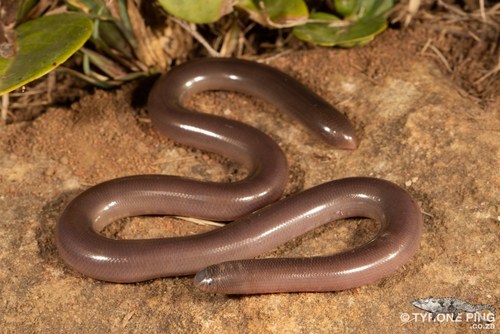
Afrotyphlops bibronii (Smith, 1846) is a heavy-bodied species of blind snake.
Coloration
It is dark olive-brown to brown on its dorsal (upper) side, and paler on its ventral (lower) side. Adult individuals are darker than juveniles.
Size
Adult A. bibronii can reach a snout-vent length (SVL) of 29.5 cm (11+5⁄8 inches).
Body Scale Arrangement
Its body scales are arranged in 30 rows around the circumference of the body, and the middorsal scale row contains more than 300 scales.
Snout Morphology
This species has a very prominent snout, with an angular but not sharp edge; the nostrils are positioned below this edge.
Rostral Scale Features
The rostral scale is very large, extending posteriorly as far back as the location of the eyes. The portion of the rostral scale visible from above is broader than it is long.
Nasal Scale Features
The nasal scales are semidivided, with the dividing suture starting from the first upper labial scale.
Preocular Scale Features
One preocular scale is present; this scale is narrower than either the nasal or the ocular scale, and it is in contact with the second upper labial.
Labial Scale Count
There are four upper labial scales in total.
Eye Placement
The eye is distinct, and sits below the suture between the ocular and preocular scales.
Head Scale Size
The prefrontal scale is much larger than the supraoculars and parietals, which are themselves larger than the regular body scales.
Body Proportions
The total body length is 28 to 36 times the diameter of the body.
Tail Morphology
The tail is short, and is either as broad as long or broader than long, ending in a small spine.
Geographic Range
A. bibronii is found in extreme southeastern Botswana, eastern and northern South Africa, Lesotho, Eswatini, and eastern Zimbabwe. It may also be present in Mozambique.
Habitat Preferences
This species prefers natural habitats of coastal grasslands and the Highveld, found at altitudes ranging from sea level up to 2,000 m (6,600 ft).
Reproductive Mode
A. bibronii is oviparous.
Egg Laying Period
Mature females lay eggs between January and March, which is late Summer in southern Africa.
Clutch Size
Clutch sizes range from 5 to 14 eggs.
Egg Dimensions
Each egg measures approximately 43 mm × 10 mm (1+11⁄16 in × 3⁄8 in).
Egg Characteristics
The embryos inside the eggs are already well-developed when laid, and the egg shells are thin.
Parental Care
Females may stay with their eggs to guard them until hatching.
Hatchling Details
Hatchlings emerge after only 5 to 6 days, and have an average total length (including tail) of 11.5 cm (4+1⁄2 in).