About Anemone quinquefolia L.
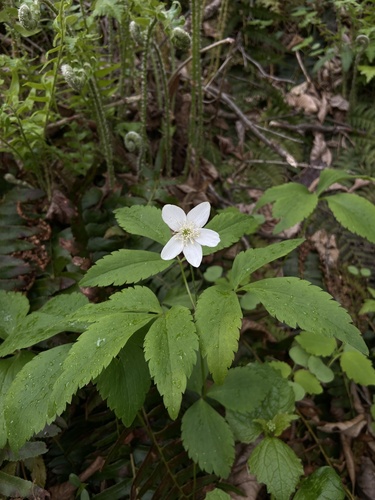
Anemone quinquefolia (also referred to as Anemonoides quinquefolia) is a perennial herbaceous plant that grows from a horizontal underground rhizome 1 to 3 millimeters thick. It produces two distinct types of leaves: stem leaves and a single basal leaf. Both the flowering stem (which bears the stem leaves) and the basal leaf grow from the same point on the underground rhizome, which makes the plant look like two separate individual plants: one flowering and one non-flowering. The flowering stem emerges first, if it emerges at all, and the basal leaf develops after the plant has finished flowering. Flowering individuals grow 5 to 20 centimeters tall, and occasionally reach heights of 30 centimeters. A whorl of three ternate, petiolate leaves, which are technically bracts, sits just below the flower. The lateral leaflets of each stem leaf may be lobed, making each leaf appear to have five leaflets. Each leaflet grows up to 5 centimeters long, has serrated edges, and branched rather than parallel veins. The flower stalk grows directly from the leaf whorl, and holds a single solitary flower. The flower is 2 to 2.5 centimeters across, and has 4 to 9 (usually 5) petal-like sepals and no true petals, along with 30 to 60 white-tipped stamens. Each sepal is 6 to 25 millimeters long and 4 to 8 millimeters wide. The sepals are most commonly white, but may occasionally be pink, pink at the base with a white tip, or white at the base with a pink or blue tip. Its fruits are beaked oblong achenes 2.5 to 4.5 millimeters long, with hooked styles. The single basal leaf is a ternate leaf with a petiole 4 to 25 centimeters long that grows directly from the rhizome. Its lateral leaflets are usually more heavily lobed than those on stem leaves, which also creates an appearance of five leaflets, which is the origin of the specific epithet quinquefolia, meaning "five-leaved". Each basal leaflet grows up to 4.5 centimeters long. This species is native to North America. Its range extends from Manitoba across the Great Lakes region to Nova Scotia, and south along the Appalachian Mountains to central Alabama. Isolated populations exist further west in Alberta, North Dakota, and Missouri. It grows best in moist open woods, thickets, and clearings, and can also be found along streams and occasionally in swampy areas. Anemonoides quinquefolia is a long-lived perennial geophyte that spreads via its underground rhizomes. Its small rhizomes grow just below the soil surface in the humus-rich layer of decaying tree leaves. As the plant spreads slowly, it can form patches several feet in diameter. An individual plant may take five years or longer to produce its first flower. This species flowers between March and June, depending on its location. It is a spring ephemeral with a very short growing season: it emerges early in spring, reproduces quickly, and dies back to its rhizome by midsummer. The flower is nyctinastic, meaning it closes at night and on cloudy days, and opens during the day. This behavior protects the plant's reproductive organs, keeps pollen viable, and may act as a defensive strategy against herbivores. This species is a myrmecochore: its seeds are dispersed by ants. Each seed has a nutrient-rich fleshy appendage called an elaiosome that attracts ants. The ranges of Anemonoides quinquefolia and Anemonoides lancifolia overlap in the southeastern United States, where the two species interbreed. The resulting hybrids have characteristics that fall between both parent species, making accurate identification extremely difficult.