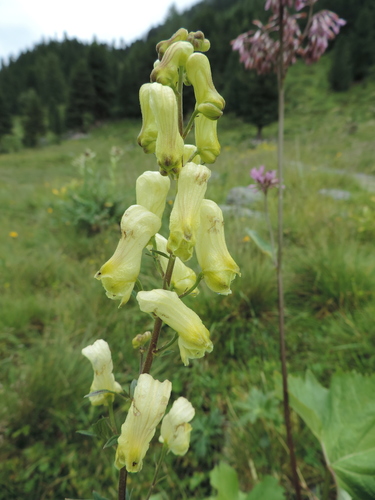
About Aconitum lycoctonum subsp. vulparia (Rchb.) Nyman
Taxonomic Classification
Aconitum lycoctonum, commonly called wolf's-bane or northern wolf's-bane, is a flowering plant species in the genus Aconitum of the family Ranunculaceae.
Native Distribution
It is native to most of Europe and northern Asia, growing from lowlands to the subalpine zone, primarily in forests and other shaded habitats. Along with A. napellus, it is one of the most common Aconitum species native to Europe.
Cultivation
It is grown as an ornamental plant in gardens, and grows well in ordinary garden soil. As a result of cultivation, it can now be found in North America, particularly in eastern Canada, where it often occurs in old gardens or grows as a garden escape.
Etymology
The specific epithet lycoctonum is a modern Latin rendering of the traditional common name "wolf's-bane". Carl Linnaeus gave the species its name, after he found A. lycoctonum growing in Lapland, Finland in 1727.
Taxonomic Complexity
High morphological variability has been observed across A. lycoctonum specimens, but molecular studies have found small genetic distances between populations. For this reason, A. lycoctonum is considered a species complex that includes multiple taxa of uncertain taxonomic rank.
Growth Form & Size
It is an herbaceous perennial plant that grows up to 1 meter tall. Its leaves are palmately lobed, with four to six deeply cut lobes.
Flower Appearance
Its flowers measure 18–25 mm long, are dark violet, and are only rarely pale yellow. All Aconitum flowers are five-petaled, zygomorphic, and protandrous.
Flower Structure
The posterior petal is shaped like a helmet, which hides two nectaries. In A. lycoctonum, the tips of these nectaries are long and highly curled, a trait that supports specialized pollination.
Reproductive Organs
The plant produces multiple stamens. Its ovary usually consists of three free carpels, but may have up to five.
Fruit Type
The fruits it produces are follicles.
Inflorescence Structure
Its inflorescence is a raceme, where flowers mature from the bottom to the top of the inflorescence. Specimens growing at high elevations typically produce more flowers per inflorescence and more inflorescences per plant than specimens growing at low elevations.
Primary Pollinators
All Aconitum species are pollinated by bumblebees of the genus Bombus. A. lycoctonum is mainly pollinated by Bombus hortorum in lowlands and Bombus gerstaeckeri in highlands; both are long-tongued bumblebee species that can reach the nectar located at the end of the nectaries.
Nectar Robbers
The flower's nectar also attracts other insects, including flies, and short-tongued bumblebees such as Bombus wurflenii. These insects act as nectar robbers, but may occasionally pollinate the plant as well.
Toxicity Overview
Like all species in the genus Aconitum, A. lycoctonum is poisonous. All parts of the plant contain numerous alkaloids, which primarily act on muscular endplates.
Root & Seed Alkaloids
Alkaloids including gigactonine, demethylenedelcorine, 14-O-methyldelphinifoline, pseudokobusine, lycoctonine, lycaconitine, and myoctonine have been isolated from the roots and seeds of A. lycoctonum.
Flower Alkaloids
Gigactonine is the main alkaloid found in the plant's flowers, alongside 6-Oacetyldemethylenedelcorine (1), 6-O-acetyl-14-O-methyldelphinifoline, 14-O-methyldelphinifoline, and lycoctonine.
Toxicity Comparison
The alkaloids in A. lycoctonum are far less toxic than those found in A. napellus. Notably, A. lycoctonum does not contain aconitine, the main toxic alkaloid of A. napellus.
Historical Medical Use
While A. napellus was used for its antipyretic and analgesic properties until recent times, medical use of A. lycoctonum became obsolete much earlier, and only mentions of this use appear in ancient texts.