About Ensatina eschscholtzii Gray, 1850
Taxon Coverage
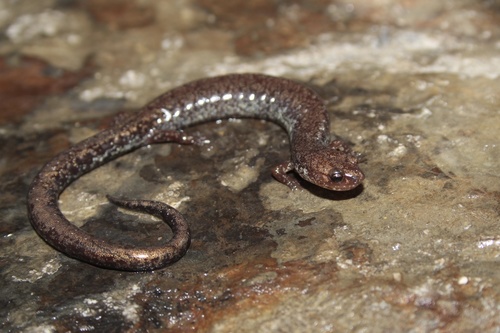
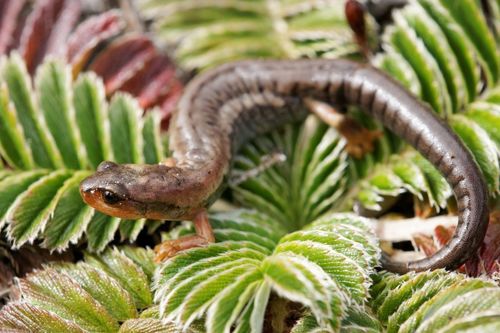
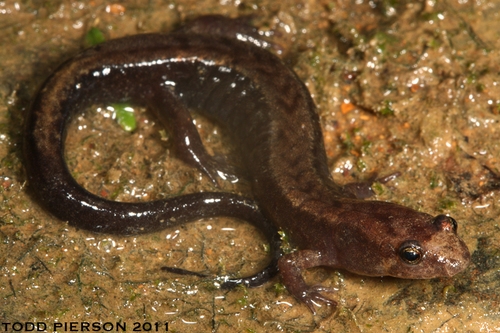
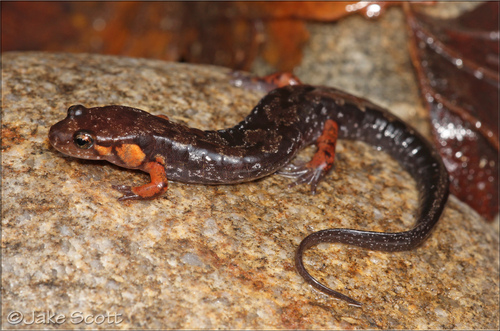
This text covers two subspecies of Ensatina eschscholtzii Gray, 1850. The first subspecies is Ensatina eschscholtzii eschscholtzii, commonly called the Monterey ensatina.
E. e. eschscholtzii Distribution
It occurs in Santa Cruz County, Monterey County, and the California coastal mountains.
E. e. eschscholtzii Size
Its total head-to-tail length ranges from 3 to 5 inches (7.6 to 12.7 cm).
E. e. eschscholtzii Identifying Features
This subspecies can be identified mainly by its tail, which is narrower at the base; it is the only Ensatina eschscholtzii subspecies that has both this tail structure and five toes on the hind limbs.
E. e. eschscholtzii Sexual Dimorphism and Coloration
Males of this subspecies often have longer tails than females, and most individuals have lighter-colored limbs compared to the rest of their body.
E. e. eschscholtzii Reproduction
Adult females lay eggs underground, usually in clutches of three, and the eggs hatch directly into fully-formed salamanders, skipping the typical aquatic juvenile phase.
Second Subspecies Introduction
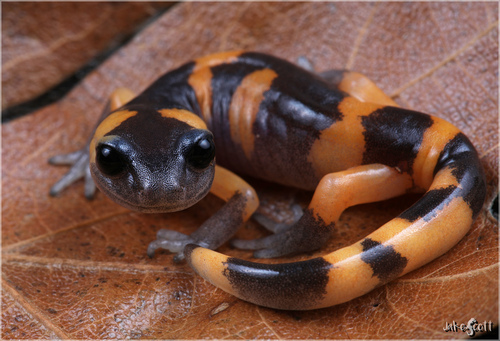
The second subspecies is Ensatina eschscholtzii klauberi, commonly called the large-blotched ensatina.
E. e. klauberi Distribution
It is found along the mountain ranges of Southern California, and extends south into a small area of the Sierra Juarez in northern Baja California.
E. e. klauberi Size
E. e. klauberi is similar in size to E. e. eschscholtzii; it is a mid-sized salamander, with adults reaching a total length of 3 to 6 inches (7.6 to 15.2 cm).
E. e. klauberi Sexual Dimorphism
Females of this subspecies typically have shorter, wider bodies than males.
E. e. klauberi Coloration
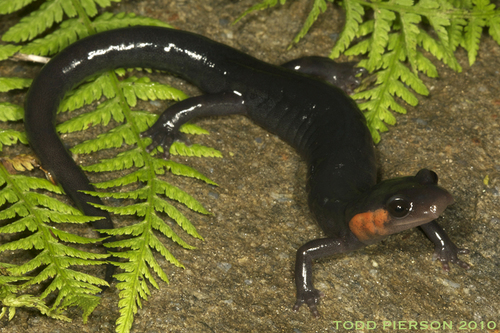
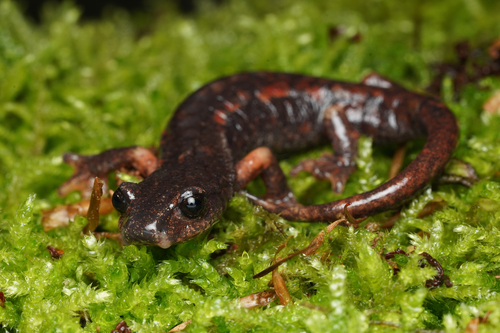
This subspecies differs from E. e. eschscholtzii in its coloration: it is nearly black with orange blotches, has a matching orange tail, and has dark eyes.
E. e. klauberi Typical Habitat
Most populations of E. e. klauberi are generally found at high elevations ranging from 520 to 2400 meters, in conifer forests and oak woodlands.
Coastal E. e. klauberi Discovery
However, new populations have been discovered along the coast at Volcán Riveroll, a volcanic area in Baja California.
Coastal Population Survival Hypothesis
It is thought that these salamanders can survive in this unexpected location because of the high coastal moisture levels.
Coastal Population Origin Hypothesis
It is unclear how these populations came to occupy this coastal region, but the hypothesis posits that the subspecies was once more broadly distributed, and became isolated in this area due to climate change during the late Pleistocene and Holocene. If this hypothesis is correct, E. e. klauberi has lived in this coastal region for thousands of years.