About Andigena nigrirostris (Waterhouse, 1839)
Subspecies Plumage Consistency
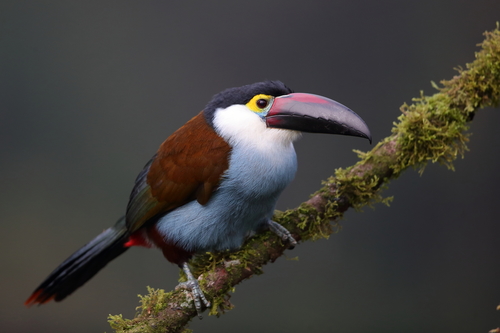
There are three subspecies of the black-billed mountain toucan, Andigena nigrirostris (Waterhouse, 1839), and all three have nearly identical plumage. All three have a black cap and nape, bronzy-colored upperparts, and a pale yellow rump.
Tail Features
The tail is dark slate, with chestnut-colored tips on the central two or three pairs of tail feathers.
Underparts Coloration
The face and throat are white, fading to pale blue on the breast; the thighs are chestnut, and the undertail coverts are red.
Periocular Bare Skin
Bare skin circles the eye: this skin is pale blue in front of the eye, and yellow or orange behind it.
Subspecies Plumage Difference
Only one plumage difference distinguishes the subspecies A. n. occidentalis from the other two: it has darker chestnut-colored thighs.
Sexual Bill Dimorphism
Within every subspecies, both sexes share the same bill pattern, but the female has a shorter bill.
Nominate Subspecies Bill
The nominate subspecies has an entirely black bill.
A. n. spilorhynchus Bill
A. n. spilorhynchus has a mostly black bill, with some dark red coloring at the base and on the upper part of the maxilla.
A. n. occidentalis Bill
A. n. occidentalis has a bill similar to that of A. n. spilorhynchus, but the red coloring on the maxilla extends more than halfway along the culmen.
Habitat Range
Black-billed mountain toucans inhabit a range of landscapes, including cloudforest, subtropical to temperate montane forest, and more open areas such as croplands adjacent to forest and open sites with scattered trees.
Elevation Distribution
Most individuals are found at elevations between 1,700 and 2,700 m (5,600 and 8,900 ft). The species rarely occurs as low as 1,200 m (3,900 ft), and has been recorded as high as 3,245 m (10,600 ft).