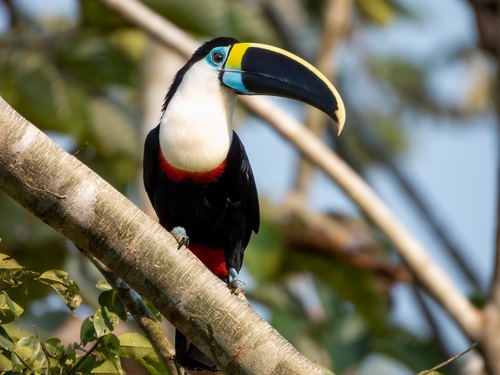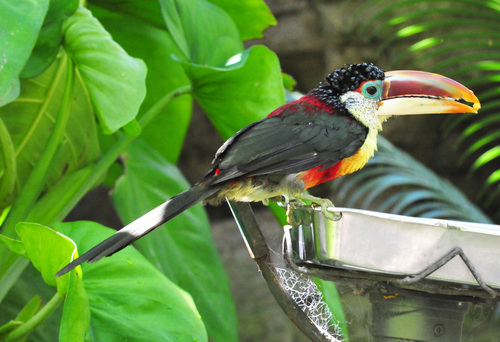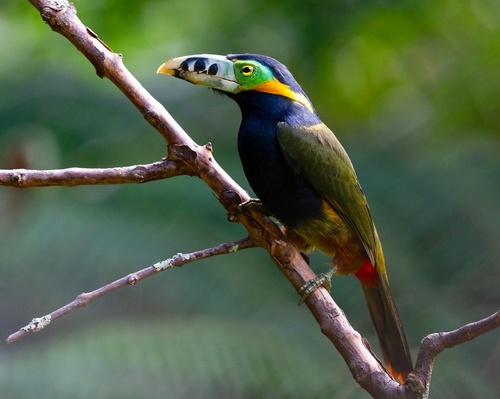
About Pteroglossus aracari (Linnaeus, 1758)
Common Name and Size
Pteroglossus aracari, commonly called the black-necked aracari, measures 43 to 46 cm (17 to 18 inches) in length and weighs 177 to 325 g (6.2 to 11 ounces).
Sexual Dimorphism
Males and females have identical plumage and bill coloration, though the female’s bill is shorter than the male’s.
Adult Nominate Head Plumage
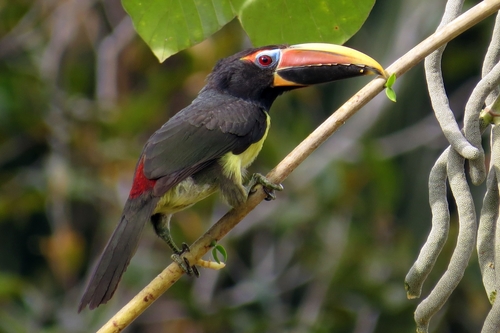
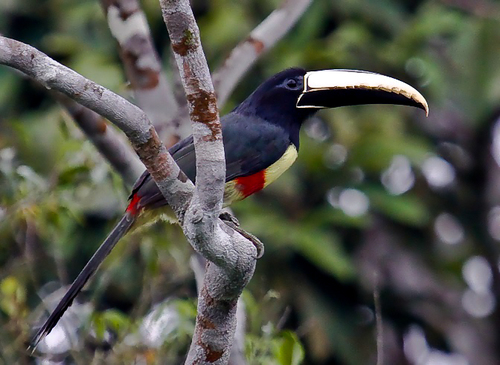
For adults of the nominate subspecies, the head, neck, and throat are black, with chestnut-black ear coverts. A brown eye is ringed by blue-gray to black bare skin.
Adult Nominate Upperparts Coloration
Most of the upperparts are green, with a red rump.
Adult Nominate Underparts Coloration
The underparts are yellow, marked by a wide red band across the lower breast and greenish thighs.
Adult Nominate Bill Structure
The bill has an ivory-colored maxilla with a black culmen and base, plus a black mandible; a vertical white line sits at the base of the bill.
Immature Plumage
Immature birds have sootier black and green plumage than adults, with paler red and yellow markings.
Immature Bill Structure
Their bills are browner, lack the distinct “teeth” marking of adults, and have no basal white line.
P. a. atricollis Subspecies Traits
Two additional subspecies differ from the nominate: P. a. atricollis has a wider brown culmen stripe on the bill, red-brown ear coverts, and cinnamon-rusty thighs.
P. a. wiedii Subspecies Traits
P. a. wiedii has a slightly wider culmen stripe than the nominate, and chestnut rather than black coloring on its ear coverts, chin, and upper throat.
Subspecies Range Segregation
Each of the three subspecies occupies a distinct range.
P. a. atricollis Distribution
P. a. atricollis is found in eastern Venezuela, the Guianas, and northern Brazil north of the Amazon River and east of the Rio Negro.
P. a. aracari Distribution
P. a. aracari, the nominate subspecies, occurs in three separate populations within Brazil: one in the northeast, south of the Amazon between the Rio Madeira and Rio Maranhão extending south to the states of Mato Grosso and Goiás; a second in far eastern Brazil in eastern Pernambuco and eastern Alagoas; and a third in southeastern Brazil in the states of Minas Gerais and Espírito Santo.
P. a. wiedii Distribution
P. a. wiedii is found in southeastern Brazil, ranging from south of the nominate subspecies’ range to eastern Paraná and Santa Catarina.
Habitat Types
The black-necked aracari lives in a wide variety of semi-open landscapes, including edges and clearings of wet forests and sand-ridge forests, secondary forest, woodlands, cerrado, gallery forest within savanna, and fruit tree plantations such as papaya plantations.
Elevation Range
It mostly occurs at elevations from sea level to around 600 m (2,000 ft), but can be found at higher elevations in Venezuela and the southeastern portion of its overall range.