About Agapornis fischeri Reichenow, 1887
Taxonomic Identity
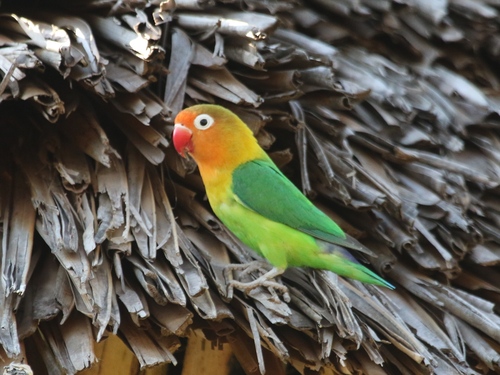
Fischer's lovebird (Agapornis fischeri Reichenow, 1887) has green back, chest, and wings.
Adult Plumage Details
Its neck is golden yellow, which darkens to deeper orange moving upward, with an olive green top of the head, a bright red beak, purple or blue feathers on the upper surface of the tail, and a distinct white circle of bare skin, called an eye-ring, around each eye.
Juvenile Plumage
Juvenile birds are very similar in appearance to adults, but their overall plumage is duller, and the base of their mandible has brown markings.
Size and Weight
This is one of the smaller lovebird species, reaching about 14 cm (5.5 in) in total length and weighing between 43 and 58 grams.
Captive Color Mutations Overview
While most wild-type Fischer's lovebirds are green, multiple color variations have been produced through captive breeding.
Blue Mutation Description
The blue variation is the most common captive mutation; lacking yellow pigment, it has bright blue back, tail, and chest, a white neck, a pale grey head, and a pale pink beak.
Blue Mutation Origin
This blue mutation was first bred by R. Horsham in South Africa in 1957.
Lutino Mutation Description
A yellow lutino mutation, which first appeared in France, produces birds that are typically pale yellow overall with an orange face and a red beak.
Other Captive Mutations
Additional mutations that have been bred include pied, black or dark eyed white, cinnamon, white, and albino variants.
Native Range
Fischer's lovebird is native to a small area of east-central Africa, located south and southeast of Lake Victoria in northern Tanzania.
Drought Movement Patterns
During years with drought, some individuals move west into Rwanda and Burundi to seek moister habitats.
Native Habitat and Elevation
The species lives in small flocks at elevations between 1,100 and 2,200 m (3,600 and 7,200 ft), where it occupies isolated clumps of trees separated by grass plains.
Wild Population Estimate
The global wild population is estimated to number between 290,000 and 1,000,000 individuals, with low population densities outside of protected areas due to capture for the pet trade.
Conservation Protection Measure
To halt further population decline, export licenses for wild-caught Fischer's lovebirds were suspended in 1992.
Non-Established Introduced Populations
Escaped captive individuals have been observed in the wild in Puerto Rico and Florida, but these are not considered established populations, as no reproduction has been recorded there.
Established Introduced Population
An established wild population of around 100 mating pairs exists in the area between Porches, Armacao de Pera, and Lagoa in the Algarve region of Portugal.
Additional Escape Records
Escaped individuals have also been observed in the U.S. Virgin Islands.
Diet Composition
Fischer's lovebirds feed on a wide variety of foods, including seeds and fruit.
Agricultural Pest Status
They sometimes act as agricultural pests, eating cultivated crops such as maize and millet.