About Agkistrodon russeolus Gloyd, 1972
Adult Total Length
Adult Agkistrodon russeolus may reach a total length including the tail of over 100 cm (39 in). In 1990, Gloyd and Conant reported that the largest specimens they observed came from Pisté, Yucatán: one was a 105 cm (41 in) male with a missing tail tip, and the other was a 101 cm (40 in) female.
Tail Length Proportion
On average, tail length makes up 19.2% of total body length in males, and 16% in females.
Scalation Traits
This species has the following scalation traits: 23 rows of keeled dorsal scales at midbody; between 131 and 141 ventral scales; and between 46 and 62 subcaudal scales, most of which are paired, particularly close to the tail tip.
Dorsal Color Pattern
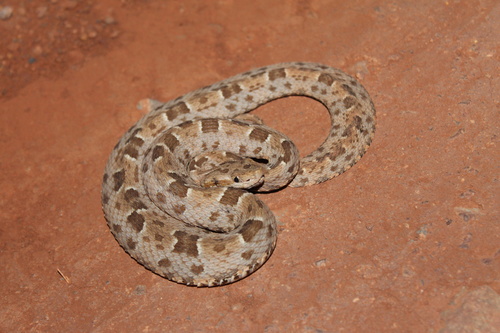
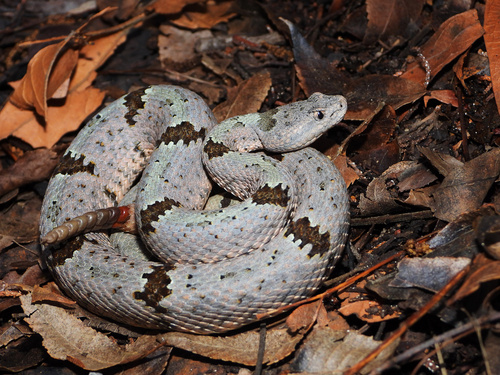
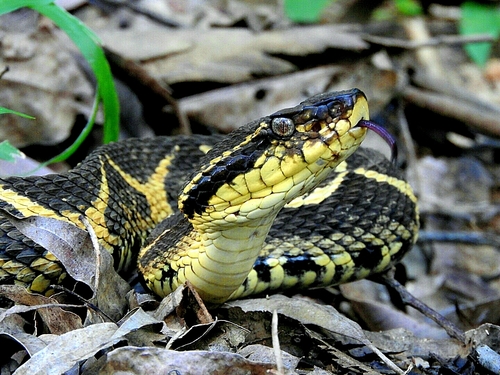
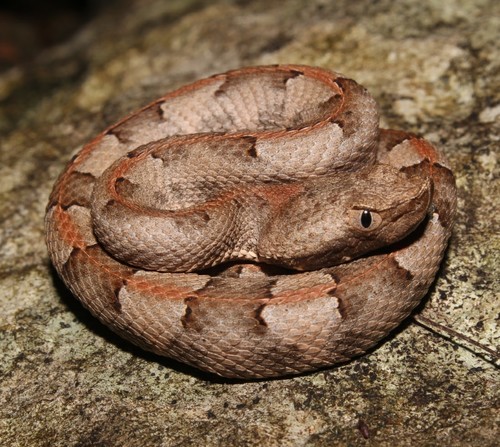
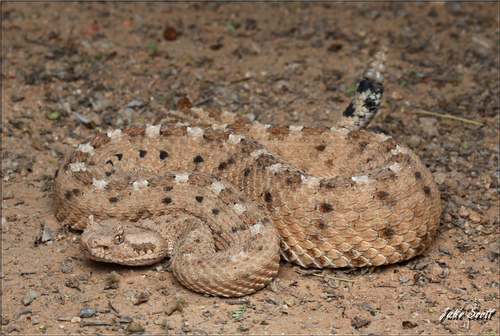
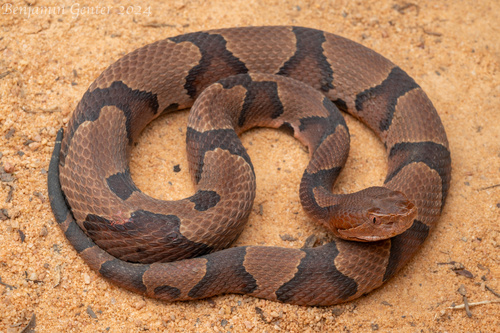
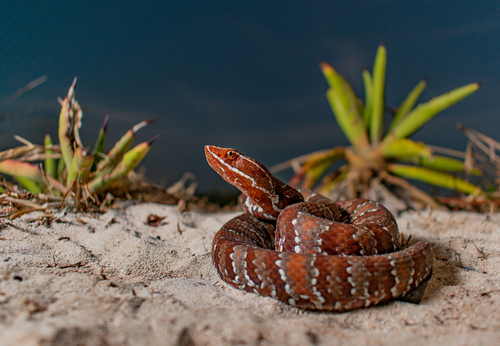
Its dorsal color pattern has a base shade ranging from light brown to deep reddish brown, marked with 12 to 18 broad brown or brownish crossbands. Along the sides, these crossbands are lighter in color at their center and usually hold one or two dark spots.
Head Markings
The head has two distinct longitudinal light lines on each side: the upper line is narrow and may be broken behind the eye, while the lower line is wider and separated from the mouth commissure by a dark band.
Geographic Range
Agkistrodon russeolus is found on the Yucatán Peninsula. Its type locality is "11.7 km north of Pisté, Yucatán, Mexico."
Northern Distribution Records
Most recorded specimens come from the semi-arid northern regions of the peninsula within the Mexican state of Yucatán.
Southern Distribution Records
That said, there are scattered additional records from various isolated southern localities, located in the Mexican states of Campeche and Tabasco, the area near the border between Quintana Roo and Belize, and northern Guatemala.
Distribution Pattern Parallels
This distribution pattern—continuous, unbroken occurrence in the north and several isolated, disjunct populations in the south—is shared by multiple other reptile species native to the Yucatán Peninsula.
Preferred Habitat Type
The preferred natural habitat of Agkistrodon russeolus is forest.
Northern Peninsula Habitat
The northern Yucatán Peninsula is dominated by low, deciduous scrub forest (Yucatán dry forests), growing on thin soils over a porous limestone karst landscape. Surface water is rare or entirely absent in this region.
Northern Vegetation Zones
Northern vegetation zones have been described as tropical deciduous forest that can reach heights of 20 m (66 ft) in some areas, and 5–7 m (16–23 ft) tall thorn forest that is impenetrable in parts of the far north.
Southern Peninsula Vegetation
Southern parts of the peninsula, including most of the Mexican states of Quintana Roo and Campeche, northern Belize, and northern El Petén in Guatemala, support tropical evergreen forest that averages 25–30 m (82–98 ft) in height.
Forest Canopy Structure
In some areas the forest canopy is closed, with a dense understory of vines and shrubs, while other areas have a more open canopy that lets light reach the ground.