About Crotalus cerastes Hallowell, 1854
Scientific Nomenclature & Adult Size
This small species, Crotalus cerastes Hallowell, 1854, has adult individuals measuring between 43 and 80 cm (17 and 31.5 in) in length. Unusually for this group of snakes, females grow larger than males.
Dorsal Scale Counts
Midbody typically has 21 rows of keeled dorsal scales. Males have 141 or fewer ventral scales, while females have 144 or fewer.
Common Name & Horn Function
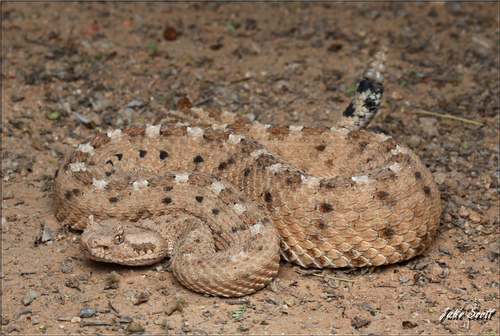
It is sometimes called the horned rattlesnake, named for the raised supraocular scales located above its eyes. This adaptation may help shade the snake’s eyes or stop sand from drifting over them when the snake lies almost buried in sand.
Horn Mechanical Property
Only pressure on the top of these horns causes them to fold down, leading to the conclusion that the horns protect the snake’s eyes when it strikes against the roof of rodent burrows.
Dorsal Color Pattern
Its color pattern has a base ground color that can be cream, buff, yellowish-brown, pink, or ash gray, overlaid with 28–47 subrhombic or subelliptical dorsal blotches. In the nominate subspecies, adult individuals have a white belly and a brown proximal lobe of the rattle.
Color Change Ability
Klauber and Neill have documented that this species can change its coloration based on temperature, a process called metachrosis.
US Distribution
This species occurs in the Southwestern United States, where it inhabits desert regions in southeastern California, southern Nevada, southwestern Utah, and western Arizona.
Mexico Distribution
In northwestern Mexico, it is found in western Sonora and eastern Baja California.
Litter Size
Females produce up to 18 young per litter, with an average of around 10.
Neonatal Birth Condition
Like most other viperids, young are born enclosed in thin embryonic membranes, and they emerge from these membranes shortly after being expelled from their mother.
Post-Birth Natal Burrow Stay
The young remain with their mother in a burrow for 7–10 days, shed their skin for the first time, then leave the natal burrow. During this period, the mother is thought to guard and protect them from predators.
Sexual Maturity & Reproductive Frequency
Sidewinders reach sexual maturity at 2–3 years of age, are capable of reproducing annually, and give birth to live young. Some females skip opportunities to reproduce, and some may even skip two years if food supplies are scarce.
Mating Season
Sidewinders mate from April through May, and sometimes mate in the fall.
Male Mating Courtship Behavior
When mating, the male crawls along the female’s back, rubbing her with his chin to stimulate or arouse her. The male then wraps his tail around her tail and attempts to bring their cloacae together.
Cloaca Function
The cloaca is the posterior body opening snakes use both to excrete waste and to reproduce.
Female Mating Receptivity
If the female is receptive to mating, she lifts her tail and allows the male to mate with her. Mating can last for several hours, and if one snake decides to move, the other is dragged along.
Multiple Mating Behavior
A single female may mate with multiple males in one mating season. Females give birth to between five and 18 young from late summer to early fall.
Newborn Size & Birthing Duration
Newborn sidewinders are 6-8 inches long at birth, and the entire birthing process takes only 2–3 hours. Within a few minutes of birth, newborn sidewinders escape from their thin, transparent embryonic membrane.
Post-Shed Dispersal
The young remain in the natal burrow for 7–10 days until they complete their first shed, after which they leave and have no further contact with their mother or littermates.
Population Density
Sidewinder population density can reach up to one individual per hectare, but they rarely encounter each other outside of mating season.
Wild Lifespan
Sidewinders have an unusually accelerated lifecycle: in the wild, females have a natural life expectancy of around 5 years. Males often live considerably longer, with a maximum known natural lifespan of 13 years.
Captive Lifespan
When well fed in captivity, sidewinders can live more than 20 years, even females. This pattern suggests energy demands are a large factor in natural female mortality, while predation is likely the primary source of mortality for males.
Mortality Causes
In the wild, females often die of exhaustion after giving birth, but sidewinder lives are also cut short by predation, disease, and encounters with vehicles.