About Phyllomedusa bicolor (Boddaert, 1772)
Size Dimorphism
This species, Phyllomedusa bicolor, has different snout–vent length measurements for males and females: males measure 91–103 mm (3.6–4.1 in), while females measure 111–119 mm (4.4–4.7 in).
Dorsal and Ventral Coloration
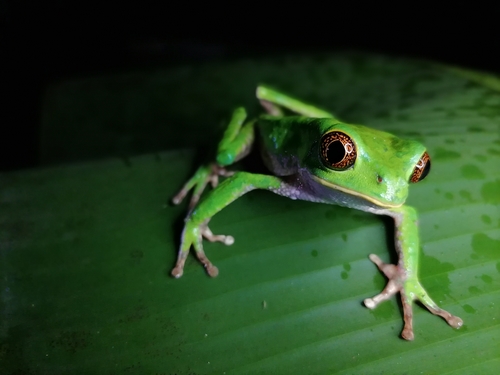
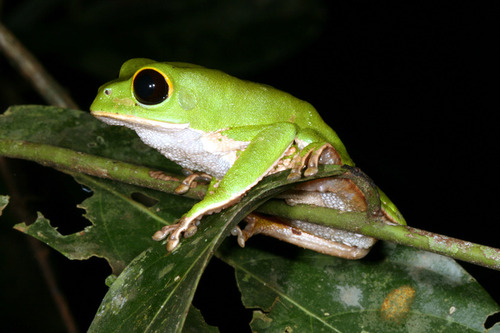
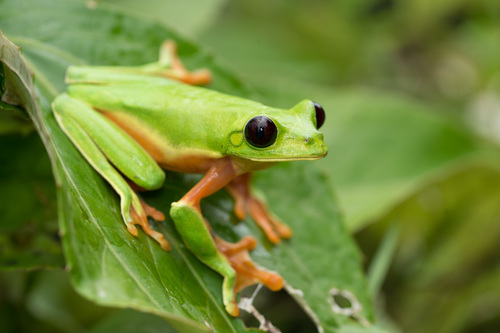
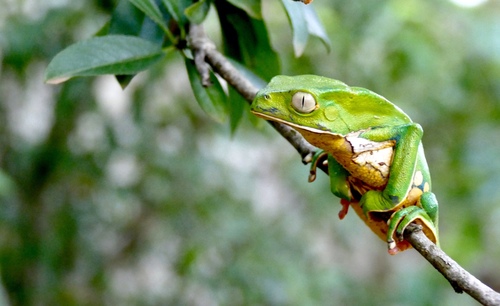
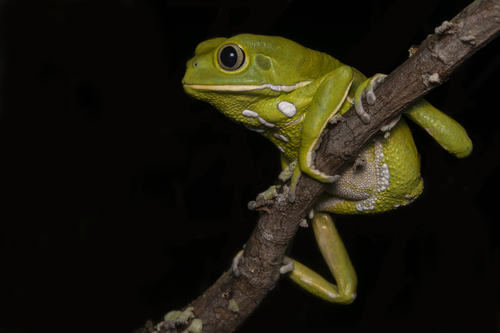
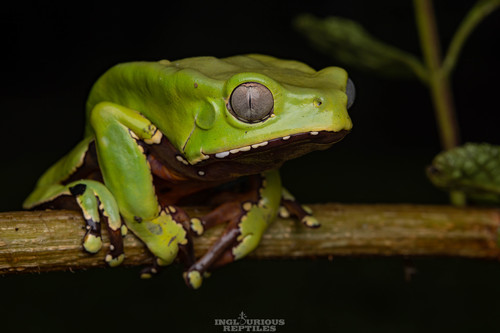
Its dorsum is lime green, and its belly ranges in color from white to yellow-white or cream.
Body Spot Pattern
Sparse white spots with dark frames appear on the lower lips, chest, and front legs, and these spots are more dense on the flanks and hind legs.
Finger Morphology
The fingers are transparent brown and have large, green adhesive discs.
Head Features
A prominent gland extends from behind each eye over the tympanum, and the iris is dark gray.
Distribution
Phyllomedusa bicolor is distributed throughout the Amazon rainforest in Bolivia, the Guianas, Brazil, Colombia, Venezuela, and Peru, and has also been found in gallery forest.
Activity Pattern
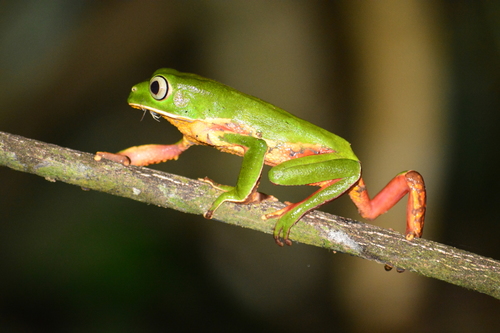
This frog, commonly called the giant leaf frog, is a nocturnal and arboreal species.
Male Mating Call
Males call from trees in tropical humid forests.
Male-Male Competition Behavior
When competing for mating opportunities, males fight other males that are already attached to females by attempting to push them away with their heads. They also fend off rivals with aggressive calls and by pushing rivals away with their hind legs.
Mating Season Predation Risk
During mating season, males face higher risk of predation, because their loud vocal fights are easy for predators to locate.
Chemical Defense
To counter this threat, giant leaf frogs produce peptides in their skin that act as a chemical defense.
Reproductive Method
Giant leaf frogs reproduce via amplexus, the same method used by most frog species, where the male climbs onto the female's back to fertilize her eggs.
Nest Construction
The mating pair builds a leaf-nest above forest pools, laying eggs in a gelatinous mass positioned about 70 cm above the water.
Egg and Tadpole Development
Eggs hatch after approximately 14 days, and the tadpoles fall into the water, where they complete their development into adult frogs.
Reproductive Timing
Peak reproductive activity occurs during the rainy season.
Egg Predation Rate
Giant leaf frog eggs face very high predation, with a predation rate reaching up to 61%.
Egg Predator Species
Egg predators include rove beetles, phorid flies, mammals (specifically capuchin monkeys), and other predators such as snakes.
Egg Predation Rationale
Predators target the eggs as a source of protein.
Skin Secretion Components
The skin secretion of the giant leaf frog is called Vacina do sapo, meaning frog vaccine, and contains the opioid peptides deltorphin, deltorphin I, deltorphin II, and dermorphin.
Cultural Use of Secretion
This secretion, known as Kambo or Sapo, is increasingly used in cleansing rituals that induce intense vomiting.