About Actaea rubra (Aiton) Willd.
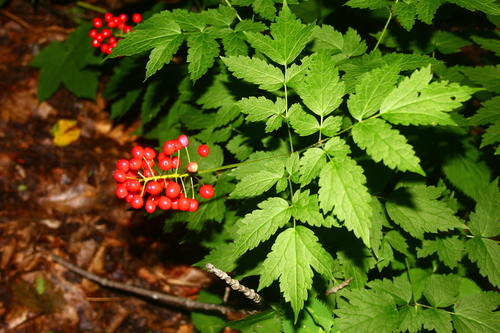
Actaea rubra (Aiton) Willd. is a perennial herb that grows 40 to 80 cm (16 to 31 in) tall. Its leaves have coarsely toothed, deeply lobed margins, and the undersides of the foliage commonly have hairy veins. Each stem either bears three leaves that branch near the top, or holds three compound leaves and one upright flowering stalk that emerge from a single point on the main central stem. This plant produces one to a few ternately branched stems that carry flower clusters. The flowers have 3 to 5 petal-like, obovate sepals that remain attached after flowering. In contrast, the petals are deciduous and fall away after flowering finishes; petals are clawed at the base, 2.5 to 4 mm (0.10 to 0.16 in) long, and range from spatulate to obovate in shape. Flowers have numerous white stamens. After flowering, green ellipsoid berries containing several seeds develop. From mid to late summer, the berries turn bright red, or white in the forma neglecta variant, and each berry has a black dot. This species grows in shady areas with moist to wet soils, as well as in open forest or on dry slopes across most of North America. It is absent from Greenland, Nunavut, Mexico, Texas, and the southeastern United States. In Alaska, it is found from the Kenai Peninsula, through Kodiak Island and Bristol Bay, and up the Yukon River. In 2016, NatureServe evaluated Actaea rubra as globally secure (G5). It holds the status of apparently secure (S4) in Iowa, Labrador, Montana, Nebraska, the Northwest Territories, Prince Edward Island, and Wyoming; it is classified as locally vulnerable (S3) in Arizona, Illinois, and the Yukon Territory; imperiled (S2) in Ohio and Pennsylvania; and critically imperiled (S1) in Indiana and Rhode Island. This plant grows slowly and takes several years to reach a size large enough to flower. Two subspecies are recognized: the western subspecies ssp. arguta, and the northern subspecies ssp. rubra. These subspecies are not well differentiated, and they intergrade with one another across much of their overlapping ranges. Grazing animals rarely consume this plant’s foliage. The plant’s poisonous berries are harmless to birds, which are this species’ primary seed disperser. All parts of Actaea rubra are poisonous, though accidental poisoning is unlikely because the berries are extremely bitter. The berries are the most toxic part of the plant: a healthy adult can develop poisoning after eating as few as six berries. Ingesting the berries causes nausea, dizziness, increased pulse, and severe gastrointestinal discomfort. The toxins have an immediate sedative effect on cardiac muscle tissue, which can potentially lead to cardiac arrest if the toxins enter the bloodstream. As few as two berries can be fatal to a child. The fruits and foliage contain ranunculin, and are often reported to contain protoanemonin. The plant also contains berberine. All parts contain an irritant oil that is most concentrated in the roots and berries. The roots contain β-sitosterol glucoside. No cases of severe poisoning or deaths from this species have been reported in North America, though children have been fatally poisoned by its European relative A. spicata. Poisoning from eating this species’ fruits is also considered unlikely. Actaea rubra is commonly called red baneberry, and it closely resembles mountain sweetroot (Osmorhiza chilensis), leading to occasional misidentification. Unlike mountain sweetroot, red baneberry does not have a strong anise-like "spicy celery" odor. One recorded non-fatal case of experimental self-intoxication from eating Actaea rubra fruit described symptoms starting within 30 minutes. The affected person first reported seeing a wide range of blue objects of different sizes and tints, which were circular with irregular edges. As they focused on these spots, they felt a heavy weight settle on top of their head that remained, alongside sharp pains shooting through the temples. Suddenly their mind became confused, and they were completely unable to recall anything distinctly or organize ideas coherently. When they attempted to speak, they used incorrect names for objects; even though they were aware they were making speech mistakes, the wrong words were spoken anyway. For several minutes they experienced severe dizziness, with the sensation that their body was swinging into space, while the blue spots changed into dancing sparks of fire. Their lips and throat became dry, and their throat felt somewhat constricted, making swallowing difficult. They developed intense burning in the stomach accompanied by gaseous burping, followed by sharp colicky abdominal pain, as well as pain across the lower back over the kidneys. Their pulse rose to 125, and was irregular, wiry, and tense, with an unpleasant fluttering sensation in the heart. These symptoms lasted around an hour, followed by a feeling of extreme weariness, but all symptoms had resolved and the person felt normal again three hours after ingesting the fruit. Actaea rubra is cultivated in shade gardens for its attractive berries and upright clump-forming growth habit. Native Americans have traditionally used juice from the fruits of various baneberry species to poison arrows.