About Pulsatilla cernua (Thunb.) Bercht. & J.Presl
Pulsatilla cernua (Thunb.) Bercht. & J.Presl is a herbaceous plant that ranges from 15 to 45 cm (6 to 18 inches) tall, and is covered in long, soft, simple hairs.
Rhizome Structure
It grows from rhizomes that measure 6–12 cm (2–5 in) long and 7–12 mm (0.3–0.5 in) in diameter.
Leaf Development
Each plant produces 3 to 6 or more leaves, which are not fully developed when the plant begins flowering. The leaves grow on petioles 4.5–18 cm (2–7 in) long, and are pinnate, with 5 to 7 three-lobed leaflets. Full-grown leaves are 3.5–12 cm (1.4–4.7 in) long and 4–11 cm (1.6–4.3 in) wide.
Scape and Bracts
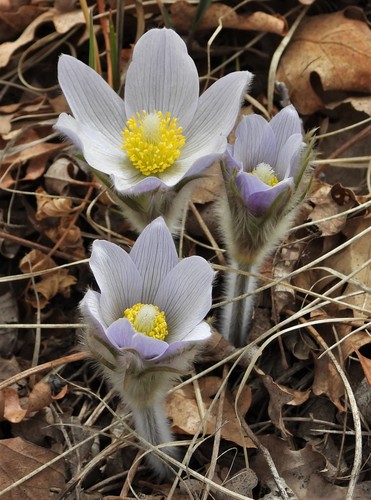
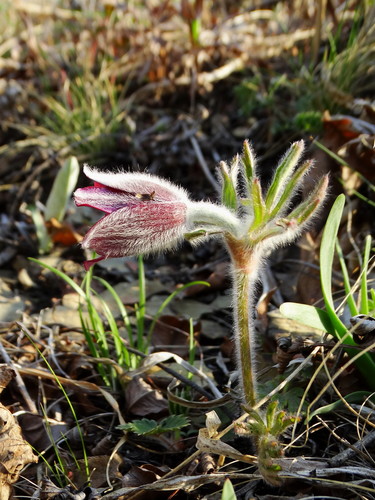
Flowers are borne on scapes 7–18 cm (3–7 in) long, which carry three bracts. Each bract is joined at the base to form a tube, then splits into three to five divisions.
Flower Features
The flowers are bell-shaped, with six generally reddish to dark purple oblong sepals. Sepals are hairy on the outer surface and measure 2–3.5 cm (0.8–1.4 in) long. Flowers contain many stamens with yellow anthers.
Fruit Characteristics
Fruits are narrow achenes, 2–5.5 mm (0.1–0.2 in) long, and are densely hairy. Each achene has an incurved beak covered in spreading hairs.
Native Range
Pulsatilla cernua is native to eastern Asia: it is found in Amur Oblast, Khabarovsk Krai, and Primorsky Krai in the Russian Far East; Inner Mongolia and Manchuria in China; Korea; and Japan.
Variety Distributions
The variety Pulsatilla cernua var. cernua does not occur in the Russian Far East, and is only found in Jeju Province, Korea. The variety Pulsatilla cernua var. koreana does not occur in Inner Mongolia or Japan.
Regional Habitats
This species is commonly found in low mountains across Japan, and on grassy slopes in northern China. In Korea, it grows on open, sunny, grassy slopes.
Soil Preferences
Pulsatilla cernua prefers moist, well-drained, sandy loam soil, which explains its occurrence in lower mountain areas and on slopes. It can grow in acidic, neutral, or basic soils, and tolerates even very alkaline conditions.
Sun Requirements
It cannot grow in shaded areas, and requires a location that receives nearly constant full sun.
Traditional Use
Pulsatilla cernua var. koreana, which has the synonym Pulsatilla koreana, is used as a traditional Korean herbal medicine.