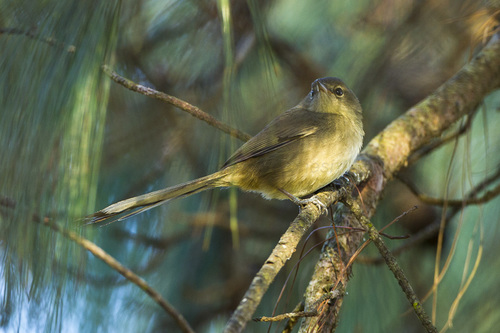
About Acrocephalus arundinaceus (Linnaeus, 1758)
Nomenclature
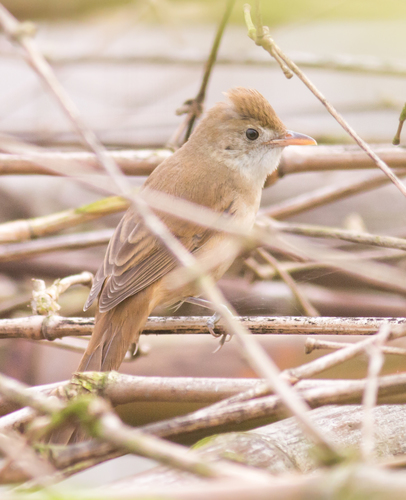
This species has the scientific name Acrocephalus arundinaceus (Linnaeus, 1758), and is commonly called the great reed warbler. A thrush-sized warbler, it is one of the largest species in both its current family Acrocephalidae and its former family Sylviidae.
Size Measurements
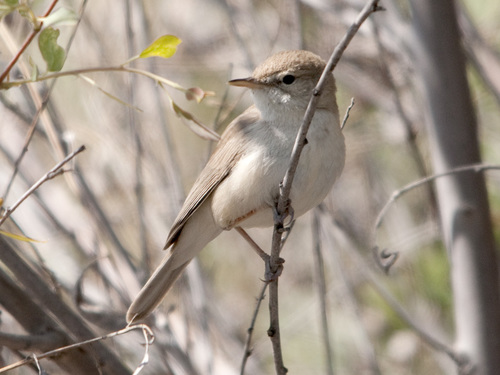
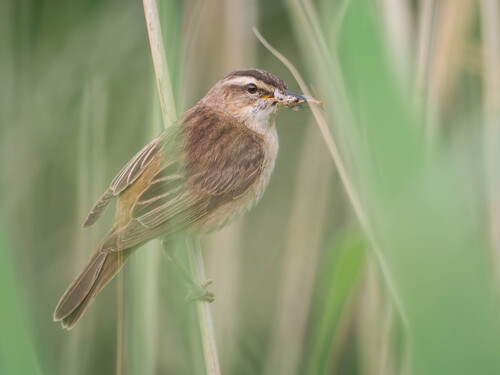
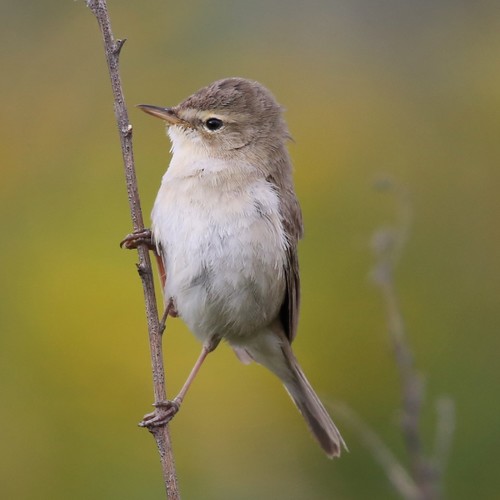
It measures 16–21 cm (6.3–8.3 in) in total length, has a wingspan of 25 to 30 cm (9.8 to 11.8 in), and weighs 22 to 38 g (0.78 to 1.34 oz). Adult great reed warblers have unstreaked brown upperparts, and dull buffish-white chins and underparts.
Head and Bill Structure
They have a flattened forehead and a strong, pointed bill. The species strongly resembles a giant common reed warbler (Acrocephalus scirpaceus), but has a more prominent supercilium.
Plumage Variation
Like most Old World warblers, male and female great reed warblers are identical in appearance; young birds have richer buff coloration on their underparts. The great reed warbler’s song is very loud and far-carrying.
Vocalization Characteristics
Its main song phrase is a chattering, croaking carr-carr-cree-cree-cree-jet-jet, with added whistles and the vocal mimicry typical of marsh warblers. The great reed warbler breeds in Europe and the western Palearctic.
Breeding Range
It does not breed in Great Britain, where only the closely related, smaller common reed warbler Acrocephalus scirpaceus occurs, and is only an irregular visitor to the region. Over recent decades, its population has increased around the eastern Baltic Sea, while it has become rarer at the western end of its range.
Migratory Pattern
It is a migratory species that winters in tropical Africa. It migrates north relatively late, and some individuals remain in their winter quarters until the end of April.
Glacial Period Population History
Mitochondrial DNA haplotype data shows that during the last glacial period, there were two allopatric populations of great reed warbler. Great reed warblers in southwestern and southeastern Europe were apparently separated at this time by the Vistulian-Würm ice sheets and the surrounding barren lands.
Historical Population Separation
While the data is not sufficient to robustly infer a date for this separation, it suggests the populations became separated around 80,000 years ago, coinciding with the first major advance of the ice sheets. The populations expanded their ranges again at the start of the Holocene around 13,000 years ago, and even today western birds winter in western tropical Africa, while eastern birds winter in eastern tropical Africa.
Migratory Tracking Study
Between 2017 and 2019, miniature data loggers were used to track the migratory flights of great reed warblers crossing the Mediterranean Sea and Sahara Desert between their breeding grounds at Lake Kvismaren, Sweden, and their winter quarters in sub-Saharan Africa. When flying over the Sahara Desert, some individuals ascended to altitudes exceeding 5,000 m, reaching a maximum of 6,267 m; as of 2023, these are the highest recorded ascents of any passerine bird.
High Altitude Flight Context
For comparison, these altitudes are higher than the summits of the highest mountains in Africa and Europe. Proposed explanations for these high-altitude flights include avoiding predation, reducing the risk of hyperthermia and dehydration, and extending the visual horizon.
Habitat Preferences
This passerine species lives in large reed beds, often with some scattered bushes. On their breeding grounds, great reed warblers are territorial.
Social Behavior
In their winter quarters, they are frequently found in large groups, and may occupy a reed bed to the exclusion of other bird species. Like most warblers, it is primarily insectivorous, but will take other small prey items, including small vertebrates such as tadpoles.
Population Dynamics
The great reed warbler experiences marked long-term population fluctuations, and is able to expand its range quickly when new suitable habitat becomes available. This common, widespread bird is classified as a species of least concern by the IUCN.
Population Estimation Methods
Population size can be estimated with a habitat suitability model, but direct counts of territorial males in suitable habitat paired with population sex-ratio sampling is a valid alternative to complex predictive modeling that relies on imperfect large-scale habitat extrapolation of reed warbler population densities.