About Acritoscincus duperreyi (Gray, 1838)
Body Striping
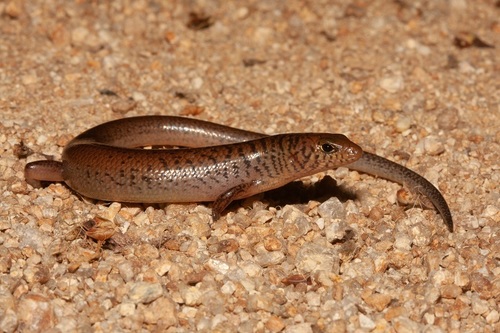
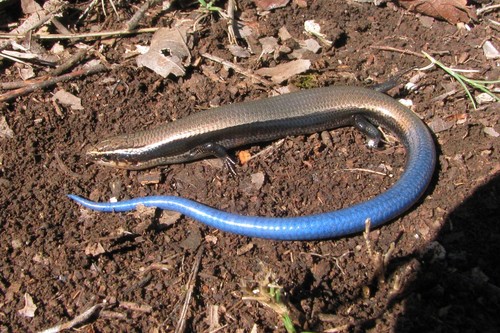
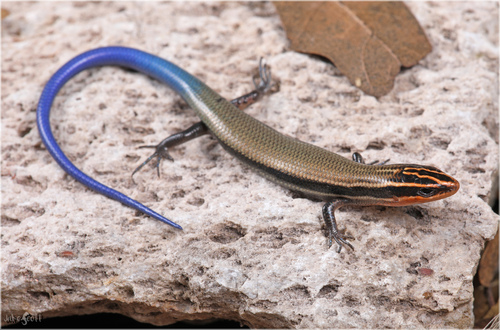
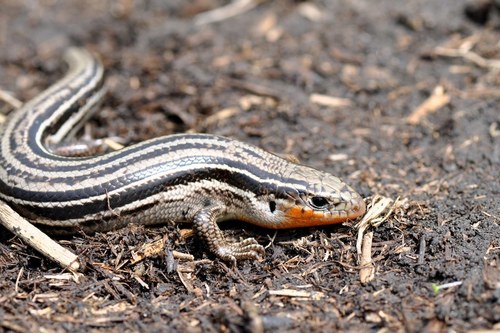
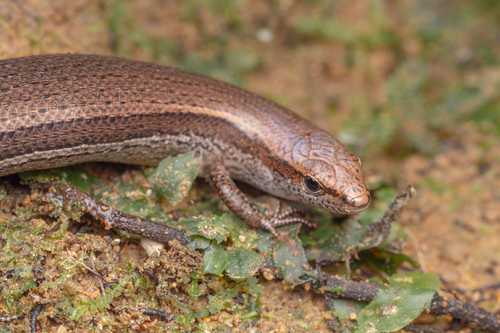
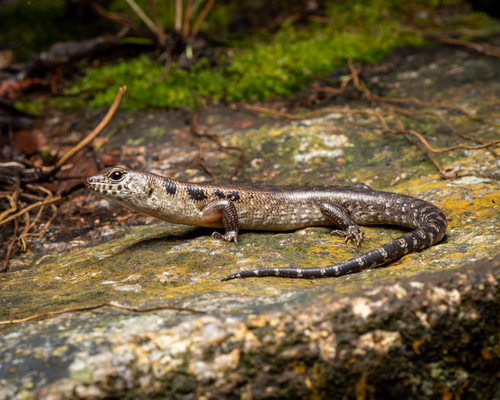
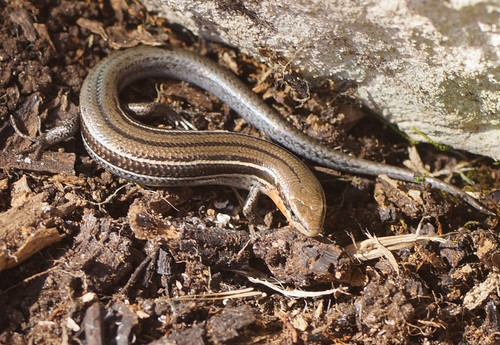
Acritoscincus duperreyi is a skink species that has strong, distinct longitudinal stripes along its body. Black or grey stripes usually run along its sides, and an additional black stripe runs down its spine.
Hatchling Throat Coloration
Hatchlings typically have bright red colouration on the throat, which fades to orange-pink or disappears entirely within a few weeks after hatching.
Adult Body Size
This skink is comparatively small-bodied, with a maximum snout-tail length of 80 millimeters.
Bassiana Hatchling Head Size
Hatchlings of the genus Bassiana have relatively larger heads than adult individuals.
Maxillary Tooth Count
Unlike most skink species, A. duperreyi has more than 22 maxillary teeth.
Autonomous Tail Morphology
Like many other skinks, however, A. duperreyi has an autonomous tail that can easily detach from its body, thanks to specialized musculature and a caudal fracture plate.
1972 Population Classification
In 1972, Pengilley identified three distinct populations (forms) of A. duperreyi based on external appearance: Form A, Form B, and Form C.
Form A Identification Traits
Form A can be told apart from Form B by its non-continuous dark vertebral stripe, and the upper light line rarely occurs in the middle of a scale row.
Form C Identification Traits
Form C also has a broken vertebral line, but the break typically splits the line into spots rather than the shorter segments seen in Form A; Form C also usually lacks a lateral line.
Population Form Geographic Ranges
Form A is associated with south-western Australia, Form B has been recorded at Barrington Tops in New South Wales, Kangaroo Island in South Australia, and Flinders Island, Tasmania, and Form C has been found in New South Wales.
Overall Species Distribution
A. duperreyi is distributed across south-eastern Australia, including the states of New South Wales, South Australia, Tasmania, and Victoria, as well as several islands: Babel Island, Big Dog Island, Flinders Island, Little Dog Island, and Maria Island.
Habitat Types
Its habitats include grasslands, wet-dry sclerophyll forests, temperate forests, temperate shrublands, human-developed pasturelands, and alpine regions.
Climate and Elevation Range
It is particularly abundant in cool climate regions of south-eastern Australia. While it is common in high-elevation areas, it does not occur at elevations above 1,650 meters.
Reproductive Mode
A. duperreyi is oviparous, meaning it reproduces by laying eggs that hatch to produce young.
Clutch Characteristics
Females lay eggs once per year in early summer, with clutch sizes ranging from 3 to 9 eggs.
Nest Site Preferences
Gravid females usually lay their eggs at communal nesting sites, which are typically located in open areas, under logs, or under rocks. Females prefer to lay eggs in sunny locations, and A. duperreyi nests are typically shallower than nests of other reptile species.
Communal Nesting Prevalence
In an 11-year study of A. duperreyi nests, 64% of all observed nests were communal.
Temporal Stability of Nesting Patterns
Even though nest-site availability changes substantially over time in A. duperreyi habitat, communal nesting patterns show very little temporal variation.
Nest Temperature Comparison
There is also no significant temperature difference between solitary and communal A. duperreyi nests.
Egg Water Content Difference
Eggs from communal nests have lower water content than eggs from solitary nests, but hatchlings from communal nests are larger in overall size.
Hatchling Trait Differences
Hatchlings from communal nests also have shorter tails and tend to run faster than hatchlings that come from solitary nests.