About Acacia viscidula Benth.
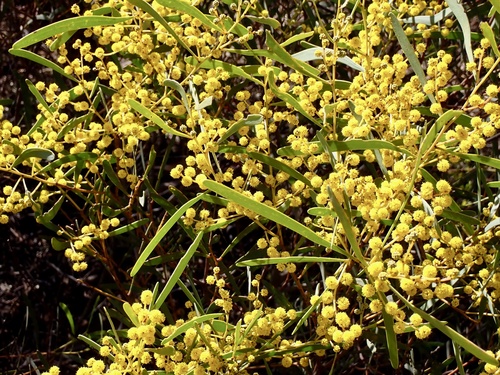
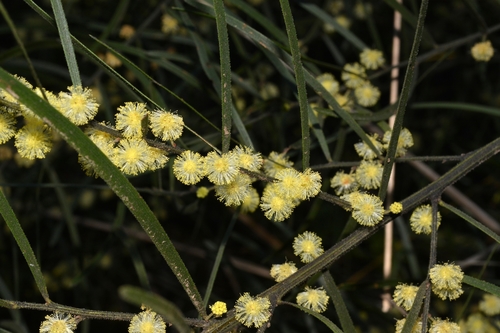
Acacia viscidula Benth. is a shrub that typically grows 1 to 4 metres (3 ft 3 in to 13 ft 1 in) tall, occasionally reaching 5 to 6 metres (16 to 20 ft), and reaches about 4 metres (13 ft) wide. It has an erect or spreading growth habit, with smooth grey or grey-brown bark. Its branchlets are angled to flattened, resinous, hairy, and ribbed. Like most Acacia species, it has phyllodes instead of true leaves. The evergreen phyllodes are ascending, thin, and either hairy or glabrous; they are linear in shape, may be slightly incurved, and measure 4 to 8 cm (1.6 to 3.1 in) long and 1 to 3 mm (0.039 to 0.118 in) wide. The phyllodes have three to seven impressed, distant, resinous nerves. It blooms between August and October, producing simple inflorescences that grow singly or in pairs in the axils. The inflorescences hold spherical flower-heads 4 to 7 mm in diameter, which contain 15 to 35 light to bright yellow flowers. After flowering, it forms firmly papery, hairy seed pods. The pods are usually straight, though they may be slightly curved, with surfaces that are alternately raised over each seed and sometimes slightly constricted between seeds. The pods measure 2 to 7 cm (0.79 to 2.76 in) long and 2 to 3 mm (0.079 to 0.118 in) wide, and hold longitudinally arranged seeds. This species is found in the Darling Downs region of south-eastern Queensland, and in eastern parts of New South Wales. In Queensland, its range extends west as far as Injune; in New South Wales, it extends west to around Coonabarabran. It grows in upland areas with granite-based soils, where it is usually a component of low woodland communities alongside Eucalyptus species and other acacias. In New South Wales, it occurs mostly in the Tablelands Region, ranging from around Tamworth in the south out to Mount Kaputar National Park in the west, and to around Tenterfield in the north-west. It is most commonly found in dry sclerophyll forest communities, or growing among heath in the crevices of granite outcrops. This plant is available commercially both as seedlings and as seed. Seeds must be treated with boiling water before sowing. Propagation via cuttings is thought to be possible. It is useful as a screen or informal hedge. Its often dense growth habit makes it a suitable nesting site for small native birds. It is fast-growing, tolerates full sun or partial shade, withstands light frost, and is drought tolerant once established. It prefers well-drained soil.