About Erythrina crista-galli L.
Erythrina crista-galli L. is a small tree that normally reaches 5–8 m (16–26 ft) in height, though some individuals growing in the Argentine provinces of Salta, Jujuy, and Tucumán can grow up to 10 m (33 ft) tall. Its trunk typically reaches 50 cm (20 in) in circumference.
Branch Characteristics
The woody trunk produces irregular, thorny (spiny) branches, which form an unstructured layer and die after flowering.
Root Symbiosis
This species has a taproot with nodules formed by nitrogen-fixing bacteria that live in symbiosis with the tree: the bacteria help the tree absorb nitrogen, and in exchange the tree provides the organic substances the bacteria need.
Native Distribution
This species is naturally distributed across northeastern and central western Argentina, eastern Bolivia, southern Brazil, most of Paraguay, and almost all of Uruguay.
Native Habitat
It grows in low-lying, flood-prone locations, along watercourses in the Chaco and Eastern Region, in wild gallery forest ecosystems along waterways, and in swamps and wetlands. It cannot be found in high forests or dry non-flooded areas, as it tolerates water-saturated soils very well.
Naturalized Status
It has become naturalized in parts of Australia, where it is classified as a declared weed in some regions.
Cultivation Award
In cultivation in the United Kingdom, this plant has received the Royal Horticultural Society's Award of Garden Merit.
Ornamental Use
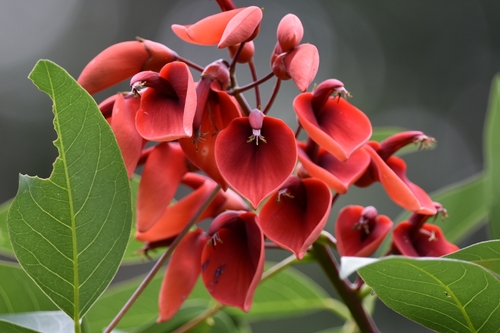
In urban areas, it is often planted in parks to showcase its bright red flowers.
Medicinal and Dye Uses
It has dye and medicinal uses: its bark treats rheumatism and wounds, and acts as a diuretic and antispasmodic; its resin can be used to cure intestinal diseases; its leaves contain camphor, which aids wound healing and has anti-inflammatory effects for tumors.