About Acacia quadrilateralis DC.
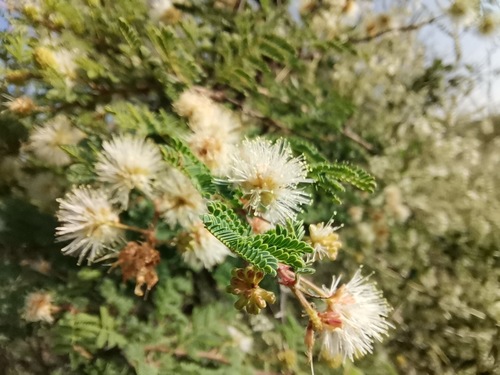
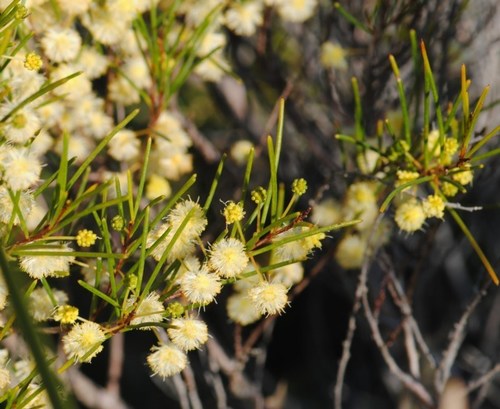
Acacia quadrilateralis DC. is a spindly shrub that can grow up to 3 metres (9.8 ft) tall, with slender, lenticellular branchlets. Like most Acacia species, it has phyllodes instead of true leaves. Phyllodes grow from short stem projections, usually appearing in groups of two or three at the nodes of mature branchlets, giving a rather crowded appearance. These slender, rigid, evergreen phyllodes range from erect to inclined, have a roughly quadrangular cross-section, and end in a sharp pungent point. They are usually 2 to 6 cm (0.79 to 2.36 in) long, 0.5 to 1 mm (0.020 to 0.039 in) wide, and marked with four main nerves. This shrub flowers between July and September, producing simple inflorescences that occur singly in leaf axils. These inflorescences hold spherical flower-heads containing 12 to 30 cream to pale yellow flowers. After flowering, it forms firmly chartaceous, dark brown seed pods that resemble a string of beads. The pods reach up to 9 cm (3.5 in) in length and 3 to 4 mm (0.12 to 0.16 in) in width, and contain longitudinally arranged seeds. The dull seeds are oblong shaped, 4 to 6 mm (0.16 to 0.24 in) long, and range in colour from black, to dark mottled brown, to yellow. This species is endemic to south eastern Queensland and north eastern New South Wales. Most of its population occurs between Bundaberg in the north and around Sydney in the south, where it grows in sandy soils over sandstone as a component of open Eucalyptus woodland communities. In the Sydney area, it is found mostly north of Botany Bay, and it is now extinct in areas further south. A small remnant population is also found on an undisturbed coastal heath headland near Ulladulla.