About Schotia brachypetala Sond.
Schotia brachypetala Sond., commonly called the weeping boer-bean, is a flowering leguminous tree belonging to the family Fabaceae (the bean, pod-bearing, or legume family) and the subfamily Detarioideae.
Native Range
This woodland tree is native to Africa south of the Zambezi River, where it grows at middle altitudes.
Cultivation Status
It is well-suited for use as a shade or ornamental tree in warmer regions, so it is widely cultivated in gardens and parks.
Etymology of Common Name
Its common name refers to the large amount of nectar that drips from its flowers, which attracts many species of birds and insects.
Additional Common Names
Other common names for this species include tree fuchsia, African greenheart, and African walnut.
General Native Habitat
This species is native to southern parts of Africa, mostly in subtropical areas.
Northern Range Limit
Its northernmost natural range is the Mashonaland escarpment just south of the Zambezi valley in Zimbabwe, at around 17°S.
Southern Inland Distribution
It grows southward to the eastern parts of South Africa, where it generally does not grow near the coast; instead, it is usually found on hills further inland, away from coastal winds.
Southern Range Limit
Its southernmost natural extent is southwest of East London in the Eastern Cape of South Africa, at around 33°S.
Habitat Preference
It grows in woodland habitats, not in forest habitats.
Population Distribution
The weeping boer-bean is not very common anywhere in its native range, and is usually scattered among other more dominant woodland trees.
Climatic Preferences
It grows best with ample summer rain, and prefers a distinct cool period during its winter resting season.
Zimbabwe Habitat Details
In Zimbabwe, it is widespread at altitudes over 1,200 metres in areas that get more than 700 mm of annual rainfall, typically growing in Brachystegia woodland.
Optimal Growth Locations
The largest, healthiest specimens grow in the midlands of Kwazulu-Natal, at altitudes between 900 and 1,200 metres.
Deciduous Trait
In inland areas, the tree is usually deciduous, especially where winters are very dry or there is a risk of frost.
New Leaf Emergence
The tree produces new leaves in spring, usually from early to mid-September.
New Leaf Coloration
Like the new leaves of many savanna trees, new weeping boer-bean leaves are a striking bright red.
Leaf Maturation
Over 7 to 10 days, the red foliage fades through bronze to dark green.
Flowering Period
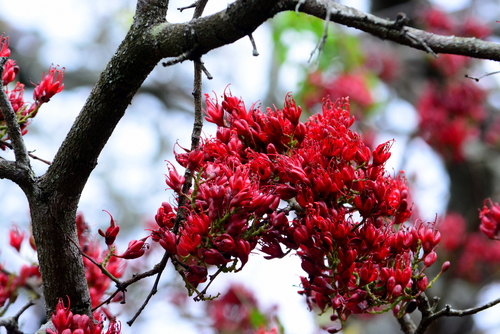
Red flowers grow directly after the new leaves emerge, during September and October, and are very attractive to bees.
Nectar Production
The flowers sometimes produce so much nectar that it drips out of the flowers.
"Weeping" Name Clarification
The "weeping" term in its common names refers to the large amount of nectar that can drip like rain from the flowers when they are shaken, not to any tendency of the tree's foliage to weep or droop.
Growth Hardiness
The weeping boer-bean is easy to grow, and it is remarkably hardy, tolerating both poor soil and very dry conditions.
Growth Rate Factors
Unfavorable growing conditions slow its growth rate, with poor conditions reducing growth speed considerably.
Optimal Growth Rate
In good quality, well-drained soil with plenty of moisture, the tree grows very quickly, and can easily reach 5 metres in height within a few years.
Exotic Cultivation in Australia
It is fairly widely cultivated outside its natural range in warm temperate and subtropical climates, especially in Australia where it is a common street tree; in Australia it is sometimes still anachronistically called a Hottentot tree.
Cultivation in Spain
It has also been planted in Spain.