About Acacia farinosa Lindl.
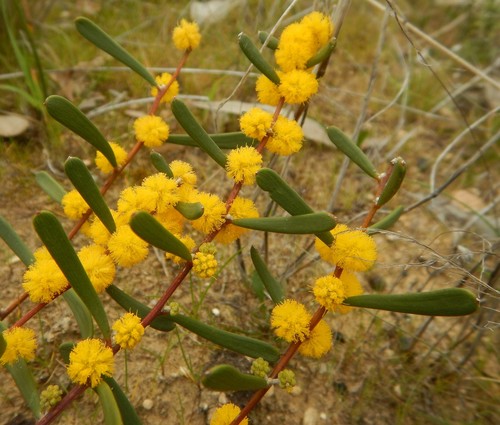
Acacia farinosa (commonly called mealy wattle) is a rounded shrub that typically grows to a height of 1 to 2 meters (3 feet 3 inches to 6 feet 7 inches). It has glabrous, terete branchlets with soft hairs pressed against their surface. Its phyllodes are ascending and shaped from oblanceolate to linear, mostly 20 to 70 millimeters (0.79 to 2.76 inches) long and 2 to 6 millimeters (0.079 to 0.236 inches) wide; phyllodes are rigid, thick, and more or less fleshy. A small gland is located 2 to 9 millimeters (0.079 to 0.354 inches) above the base of each phyllode. Flowers are borne in spherical heads on a peduncle 2 to 4 millimeters (0.079 to 0.157 inches) long. Each head is 3.5 to 4 millimeters (0.14 to 0.16 inches) in diameter and holds 7 to 17 golden yellow flowers. Flowering occurs from July to November. After flowering, it produces linear, crusty, rigid, curved, twisted pods that are glabrous, reaching up to 60 millimeters (2.4 inches) long and 2 to 3 millimeters (0.079 to 0.118 inches) wide. The seeds are elliptic, 3.5 to 4.0 millimeters (0.14 to 0.16 inches) long, black, with a small aril at one end. Mealy wattle grows mainly in sand or loam within shrubland and woodland, often in association with lerp mallee (Eucalyptus incrassata). Its range covers the Eyre and Yorke Peninsulas, Kangaroo Island, and south-eastern South Australia, and extends into western Victoria between Edenhope and Swan Hill. This species may be grown as a groundcover in coastal areas for horticultural use.