About Oxylobium ellipticum (Vent.) R.Br.
Growth Habit
Oxylobium ellipticum is a spreading, heavily branched shrub that grows up to 2 meters (6 feet 7 inches) tall.
Leaf Arrangement
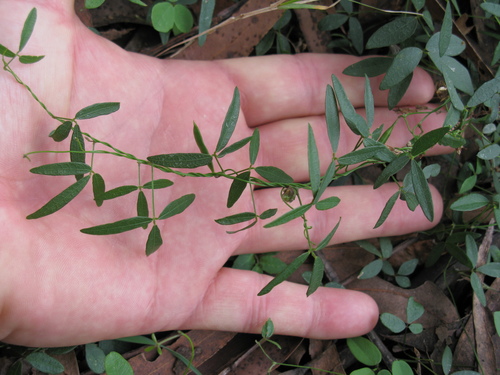
Its leaves are arranged in irregular whorls of three or four. Most leaves are elliptic, occasionally lance-shaped, and rarely heart-shaped.
Leaf Dimensions
They measure 0.5–3 cm (0.20–1.18 in) long and 3–10 mm (0.12–0.39 in) wide.
Leaf Texture and Morphology
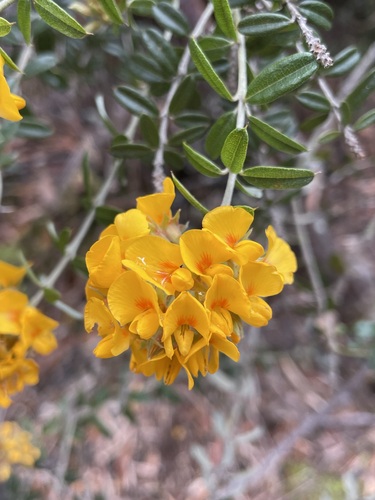
The leaves are leathery, dark green on the upper surface, and covered in brown dense woolly hairs on the underside, with visible net-like reticulate veins, recurved margins, and a blunt apex that often ends in a short sharp point.
Flower Appearance
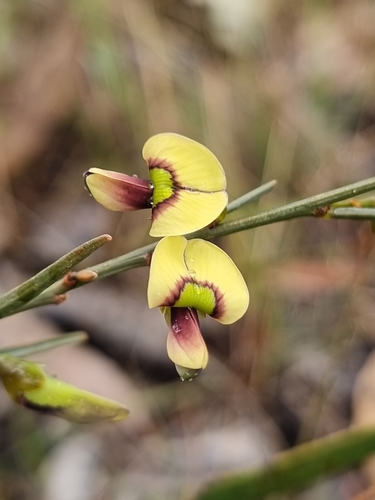
This species produces golden yellow pea-shaped flowers arranged in dense clusters at the ends of stems.
Flowering Period
Flowering takes place in spring and summer.
Fruit Characteristics
The fruit is a rounded, grey-brown oval pod that is approximately 7–8 mm (0.28–0.31 in) long and covered in long, silky hairs.
Geographic Distribution
Oxylobium ellipticum is widely distributed across montane ecosystems in Victoria, open forest and woodland on the tablelands and south-west slopes of New South Wales, and Tasmania.
Habitat and Substrate
It frequently grows on skeletal soils and organic brown peat over quartzite sand.