About Lathyrus palustris L.
Species Naming
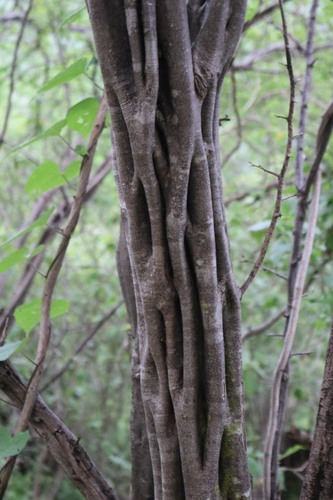
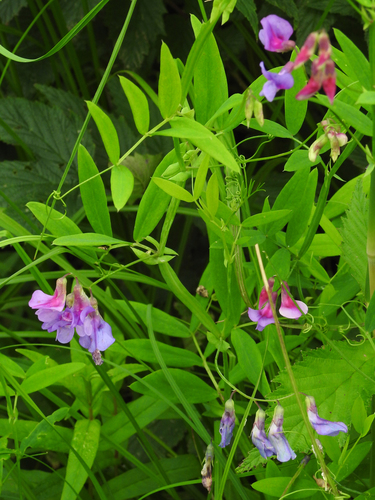
Lathyrus palustris L. (also referenced here as Lathyrus linifolius) is a perennial herb with a sprawling or climbing, shallowly winged, nearly hairless stem that reaches 25 to 80 cm (10 to 31 in) in length.
Leaf Arrangement & Stipules
Its leaves are alternate, borne on short winged stalks, and have long narrow stipules.
Leaf Blade Structure
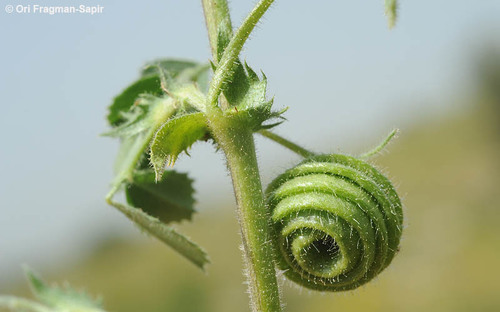
Leaf blades are pinnate, with two to four pairs of narrow lanceolate leaflets that have smooth entire margins, and end in a branching tendril.
Inflorescence & Flower Size
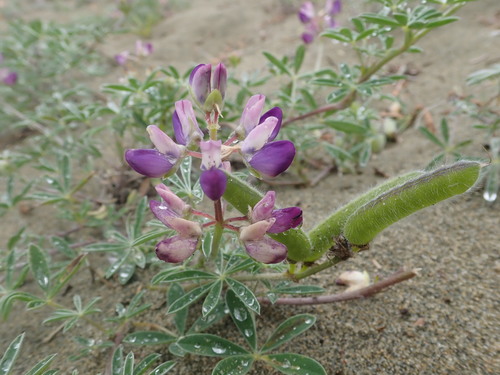
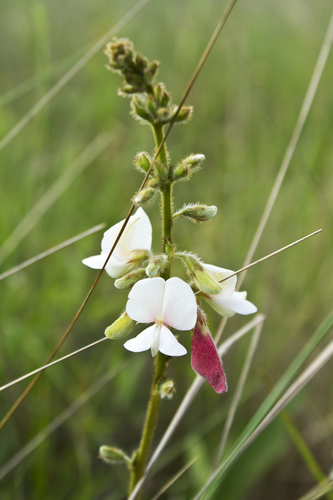
The inflorescence grows on a long stem and holds two to eight purple flowers, each 12 to 20 mm (0.5 to 0.8 in) long.
Flower Reproductive Parts
Flowers are irregular, with five sepals, five petals, ten stamens, and a single carpel.
Petal Morphology
The petals are differentiated into an uppermost "standard", two lateral "wings", and two lower petals joined to form a "keel".
Fruit & Seeds
After flowering, the plant produces a flat brown pod that holds up to twelve seeds.
Flowering Period
This plant flowers in July and August.
Native Range
It is native to Europe, parts of Asia, and North America.
Typical Habitat Types
Its typical habitat is nutrient-rich ground, including damp meadows, river banks, pond margins, lake shores, areas near the sea, and occasionally coastal hedgerows.
Associated Vegetation
It often grows among common reeds (Phragmites australis).
Etymology & Common Name
Its species epithet palustris is Latin for "of the marsh", which reflects its common habitat, and its common name Marsh Pea also refers to its occurrence in wet to moist areas.
Vegetative Reproduction
Marsh Pea grows from long rhizomes, which let it spread via vegetative reproduction.
Growth Requirements
It grows in areas with adequate sun, and uses other plants for climbing support.