About Acacia concurrens Pedley
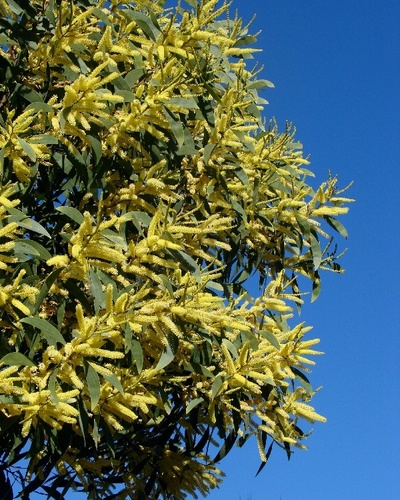
Acacia concurrens (common name curracabah) is a glabrous, glaucous single-stemmed shrub or tree that usually reaches a maximum height of 10 metres (33 feet). It has grey-black, fibrous bark with longitudinal fissures. Its branches are stout, angular, brown, and covered in scurfy scales. The species has modified leaf-like phyllodes that range from very narrowly elliptic to narrowly elliptic in shape. The upper margin of each phyllode is curved, while the lower margin is straight; phyllodes measure 80–160 mm (3.1–6.3 in) long and 12–35 mm (0.47–1.38 in) wide. Most phyllodes have 3 to 4 particularly prominent veins, with a small gland located up to 2 mm (0.079 in) above the base of the phyllode. The flowers are arranged in pale yellow spikes that are 35–110 mm (1.4–4.3 in) long. Flowering takes place between March and September. The seed pods are linear, semicircular, and shaped somewhat like a string of beads, reaching 50–100 mm (2.0–3.9 in) in length. The seeds are elliptic, brownish black, and 3.5–4.5 mm (0.14–0.18 in) long. This species is endemic to eastern Australia, where it occurs from south-eastern Queensland to northern New South Wales. It is common in coastal areas ranging from around the Mooloolah River in Queensland down to the Hastings River in New South Wales. It grows on hillsides or plateaux in sandy or stony sandy loams, often over shale, as a component of the understorey in Eucalyptus forest or woodland.