About Abies lasiocarpa (Hook.) Nutt.
Scientific name: Abies lasiocarpa (Hook.) Nutt.
Description
Tree Size and Form
Abies lasiocarpa is a medium-sized evergreen conifer with a very narrow conical crown. It typically grows to 20 m (66 ft) tall, and exceptionally reaches 40–50 m (130–160 ft). Trunks are normally up to 1 m (3 ft 3 in) thick, with exceptional specimens reaching 2.1 m (6 ft 11 in).
Bark and Lower Branches
Bark on young trees is smooth, gray, and marked with resin blisters; it becomes rough, fissured or scaly on old trees. The lowest branches are typically found 1 m (3 ft 3 in) above ground level.
Leaf Morphology
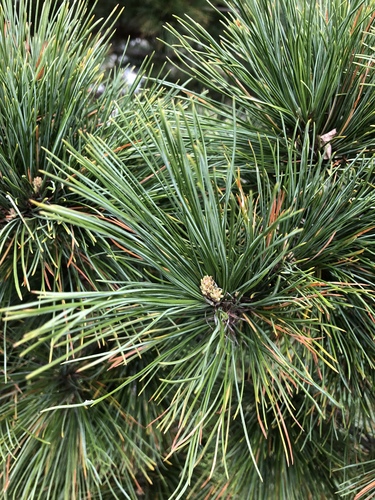
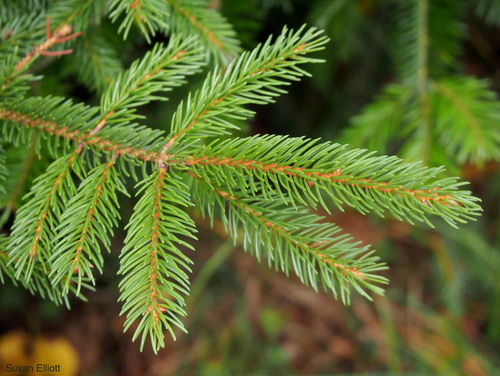
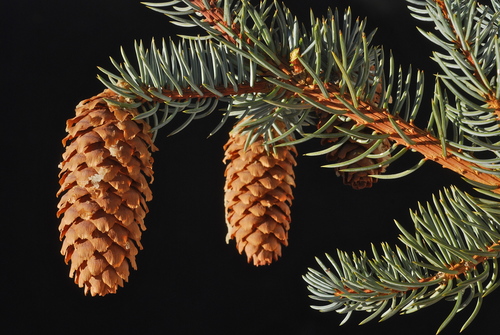
Leaves are flat, needle-like, and 1.5–3 cm (5⁄8–1+1⁄8 in) long. They are glaucous green on the upper surface with a broad stomatal stripe, and have two blue-white stomatal bands on the lower surface.
Leaf Arrangement
Fresh leaf scars are reddish (tan on the inland variety). Leaves are arranged spirally on shoots, but their bases twist to place most leaves on the sides and upper surface of the shoot, with few or no leaves below the shoot.
Cone Characteristics
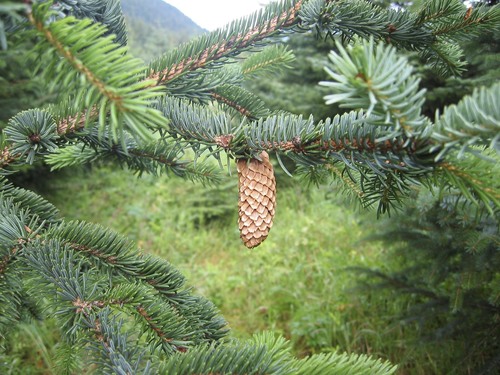
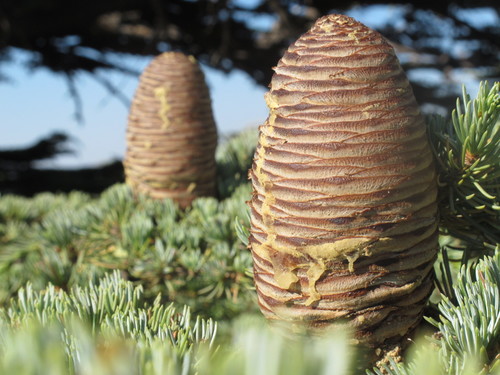
Cones are erect, 6–12 cm (2+1⁄4–4+3⁄4 in) long, and dark purple with fine yellow-brown pubescence. They ripen to brown and disintegrate to release winged seeds in early fall.
Distribution
Native Range
This species is native to mountainous areas of Western Canada (Yukon, British Columbia, and western Alberta) and the Western United States (Southeast Alaska, Washington, Oregon, Idaho, Western Montana, Wyoming, Utah, Colorado, New Mexico, Arizona, northeastern Nevada, and the Trinity Alps of the Klamath Mountains in northwestern California).
Altitudinal Range
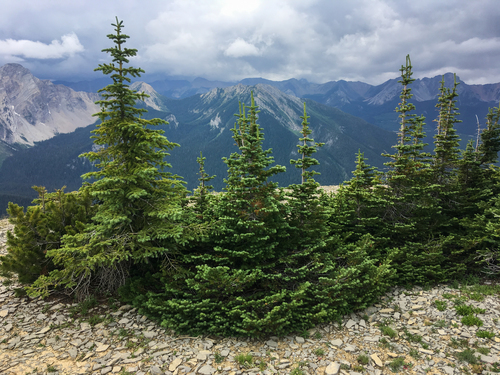
It grows at high altitudes, most commonly at and immediately below the tree line. Elevations range from 300–900 m (980–2,950 ft) in the northern part of its range (rarely as low as sea level in the far north), up to 2,400–3,650 m (7,870–11,980 ft) in the southern part.
Regional Elevation Variation
West of the Cascade ridge, it occurs at 1,200–2,000 m (3,900–6,600 ft); further east, particularly in Western Montana, it grows from 1,500 to 2,700 m (4,900 to 8,900 ft).
Ecology
Habitat Precipitation
Annual precipitation in its habitat ranges from 380 cm (150 in) at coastal mountain sites to just 65 cm (26 in) inland. Snow accumulating on branches helps protect them from wind and heat.
Snow Retention Role
As with other firs, this species acts as a snow fence, leading to extra moisture accumulation that allows meadows to form.
Growth and Survival Traits
This tree is highly shade tolerant, but very vulnerable to fire; it is short-lived and slow-growing. Although its wood is weaker than that of some timberline associate species, it can survive at high elevations via its ability to adapt by growing in a krummholz growth form and reproduce via layering in clusters.
Layering Adaptation
At timberline, a single tree may leave behind a ring of trees called an 'atoll' via layering. This species has benefited from wildfire suppression in recent decades.
Faunal Associations
Various animals use subalpine fir clusters and krummholz for shelter, including mountain goats. Game animals browse its bark, and grouse eat its leaves.
Wildlife Food and Pathogens
Seeds are consumed by songbirds, Richardson's grouse, Cascade pine squirrels, and other mammals. It is a host for the pathogenic fungus Delphinella balsameae.
Uses
Traditional Medicinal Uses
Native Americans used its leaves as deodorant, and burned them as incense or medicinal vapor. Powdered bark and other plant parts were used in preparations to treat colds.
Traditional Practical Uses
Resin was used to dress wounds and chewed as gum. Tree boughs were used for bedding.
Traditional Cultural Uses
Some Plateau Indian tribes drank or washed in a boiled subalpine fir preparation for purification or to promote hair growth.
Commercial Wood Uses
Its light wood is considered poor quality, but is sometimes used for wood pulp, general structural purposes, and paper manufacture.
Ornamental Uses
It is a popular Christmas tree, and a common ornamental tree grown in parks and large gardens for its distinctly glaucous-blue foliage. It can also be cultivated as a bonsai.
Cultivar Information
The cultivar Abies lasiocarpa var. arizonica 'Compacta' is suitable for smaller gardens, growing as a shrub to 4 m (13 ft) tall and 1.5 m (4 ft 11 in) broad. In the United Kingdom, this cultivar has received the Royal Horticultural Society's Award of Garden Merit.
Notable Specimen
The largest known specimen of this species measures 2.1 m (6 ft 11 in) thick and 39 m (129 ft) tall. It has a small door cut into its trunk that creates an interior storage space, which the film crew of the 1952 Disney documentary The Olympic Elk used to store equipment.