About Abies holophylla Maxim.
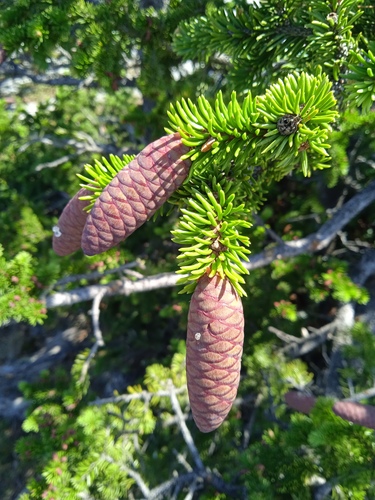
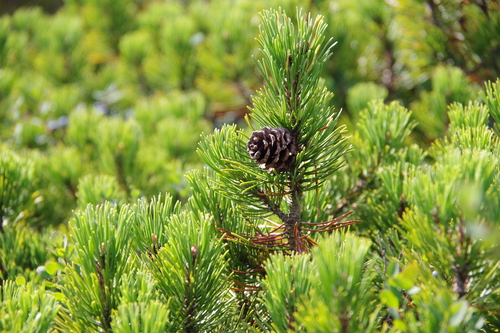
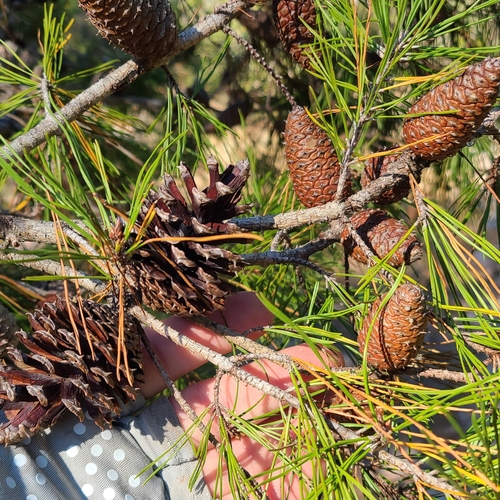
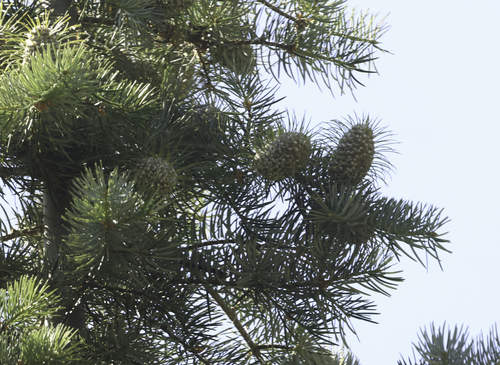
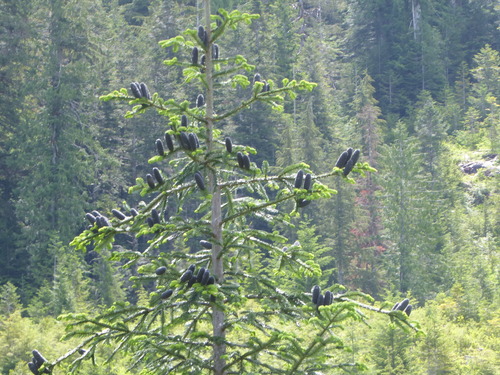
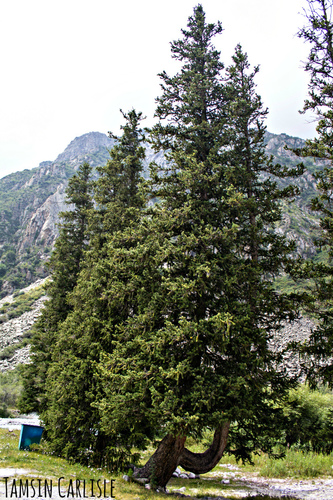
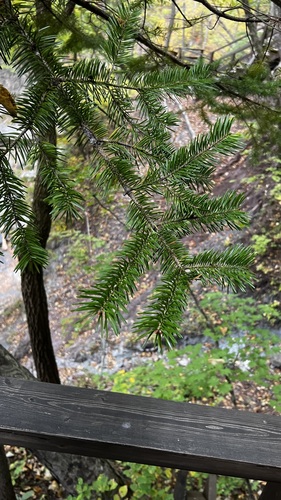
Abies holophylla, commonly known as needle fir or Manchurian fir, is a fir species native to mountainous areas of northern Korea, southern Ussuriland, and the Chinese provinces of Heilongjiang, Jilin, and Liaoning. It is an evergreen coniferous tree that grows to 30 meters (100 feet) tall with a trunk diameter of 1 meter (3 feet), and has a narrowly conical crown formed by horizontally spreading branches. Its bark is scaly, gray-brown, and marked with resin blisters. Its needle-shaped leaves are flattened, 2–4 cm (3⁄4–1+1⁄2 in) long and 1.5–2.5 mm (1⁄16–3⁄32 in) thick. They extend at right angles from the shoot and end in a point. The needles arrange on two sides of the shoot, but do not lie flat like silver fir needles. They typically angle upward to varying degrees, creating a V-shaped open space above the shoot. Unlike silver fir leaves, Manchurian fir leaves are sharp and prickly, with no indentation at the tip. The upper leaf surface is bright green, while the lower surface is whitish-green with two whitish strips, each made up of 7–10 wax-covered stomatal bands. Young shoots are hairless, shiny yellow-gray, and mature to gray-brown. Cones are 12–14 cm (4+3⁄4–5+1⁄2 in) long by 4–5 cm (1+1⁄2–2 in) wide, yellow-brown, slightly tapered, and have a bluntly rounded apex. The cone bracts are hidden beneath the cone scales. Seeds are 8–9 mm (5⁄16–3⁄8 in) long with a 1.5 cm (5⁄8 in) wedge-shaped wing, and are released when cones disintegrate at maturity in October. Manchurian fir is sometimes used as an ornamental plant, though this use is not common.