About Abies bracteata (D.Don) A.Poit.
Scientific Name and General Growth
Abies bracteata (D.Don) A.Poit. is a fir tree that typically reaches 20 to 35 meters (66 to 115 feet) in height, with a slender, spire-like growth form.
Bark Characteristics
Its thin bark is reddish-brown, marked by wrinkles, lines and resin blisters, also called vesicles.
Branch Arrangement
Its branches grow in a downswept arrangement.
Leaf Arrangement
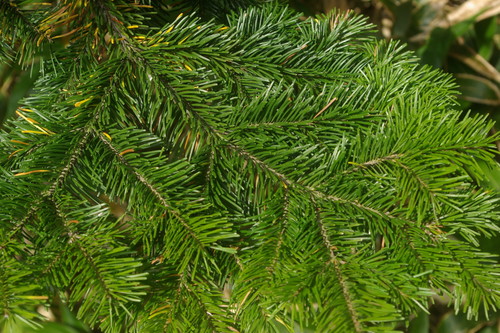
The species has needle-like leaves that are arranged spirally on shoots, but twisted at their base to spread into two moderately forward-pointing ranks on either side of the shoot, leaving a V-shaped gap above the shoot.
Leaf Morphology
The leaves are hard and stiff, with a sharply pointed tip, measuring 3.5–6 cm long and 2.5–3 mm broad, and have two bright white stomatal bands on their underside.
Flowering Period
Flowers bloom in early May.
Cone Size
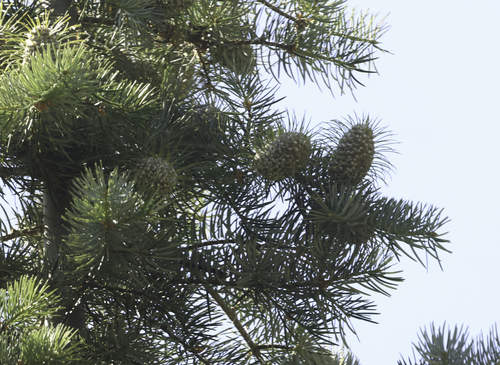
The species produces ovoid cones that are 6–9 cm long, or up to 12 cm long when including their bracts.
Cone Maturation
These cones mature and release winged seeds between late August and October.
Cone Distinguishing Features
The cones of this species differ from those of other firs because their bracts end in very long, spreading, yellow-brown bristles that measure 3–5 cm long.
Male Pollen Cones
The male pollen cones of Abies bracteata are 2 cm long, and shed pollen in spring.
Largest Living Specimen
The tallest and widest known living individual of this species was most recently measured at 38.7 metres (127 ft) in height, with a diameter at breast height (DBH) of 121 centimetres (48 in).
Largest Recorded Specimen
The tallest and widest specimen ever recorded reached 55.5 metres (182 ft) in height, with a DBH of 131 centimetres (52 in).
Ornamental Use
This tree is a popular ornamental species, and is grown in many arboreta.
Native Climate
It naturally grows in an equable Mediterranean climate that receives considerable winter precipitation and very dry summers.
Cultivation Success
It has not been successfully introduced to eastern United States, but many groves of the species thrive in cultivation in Europe.
Traditional Resin Use
Resin harvested from the trunk of this tree was used as incense by early Spanish missions.