About Abies firma Siebold & Zucc.
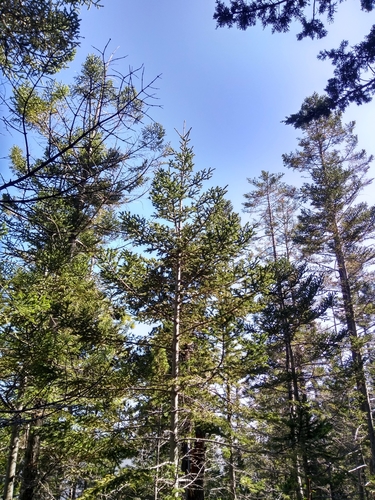
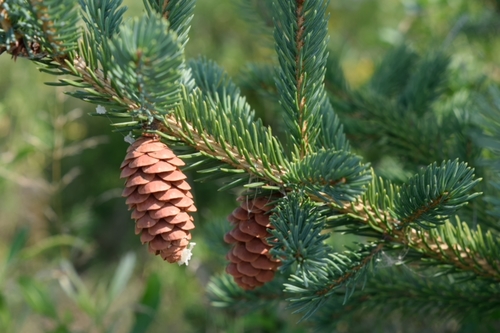
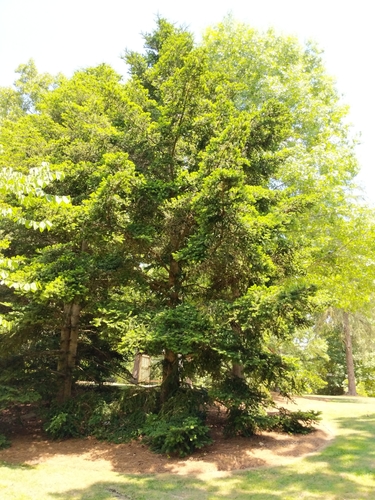
Abies firma, commonly called the momi fir, is a fir species native to central and southern Japan. It grows at low to moderate altitudes between 50 and 1200 m. It is a medium-sized to large evergreen coniferous tree, reaching up to 50 metres (160 ft) tall and 2 metres (6 ft 7 in) in trunk diameter. It has a broad conical crown, with straight branches growing at an angle of about 20° above horizontal. Its bark is scaly grey-brown, and young trees have resin blisters on their bark. Shoots are grooved, coloured buff to grey-brown, and can be either glabrous or finely pubescent. Its leaves (commonly called needles) are flattened, 2–5 centimetres (0.79–1.97 in) long and 2–4 millimetres (0.079–0.157 in) broad. Leaves spread at nearly right angles from the shoot, with a sharp apex; leaves on young trees are bifid (double-pointed), while leaves on mature trees have a single point. The upper surface of the leaf is bright green, and the lower surface is greyish-green with two broad stomatal bands. Its cones are 7–15 centimetres (2.8–5.9 in) long and 3–5 centimetres (1.2–2.0 in) wide. They start green and mature to yellow-brown, tapering to a bluntly rounded apex that is 2–3 centimetres (0.79–1.18 in) broad. The cone scale bracts are triangular and extend out 3–6 millimetres (0.12–0.24 in). The seeds are 7–9 millimetres (0.28–0.35 in) long, with a wedge-shaped wing 1.5 centimetres (0.59 in) long. Seeds are released when the cones disintegrate at maturity in October. Along with Abies homolepis, Abies firma is one of two fir species that make up the majority of Japanese temperate forest zones. Where their elevation ranges overlap, the two species hybridize to produce the hybrid Abies umbellata, also called A. x umbellata. Regrowth of Abies firma forests is currently threatened by overbrowsing from Sika deer. Momi fir is sometimes, but not commonly, planted as an ornamental tree. This use is especially common in warm temperate regions with hot, humid summers, such as the southeastern United States. In these same regions, it is also used as grafting understock for fir cultivars.