About Abies amabilis Douglas ex J.Forbes
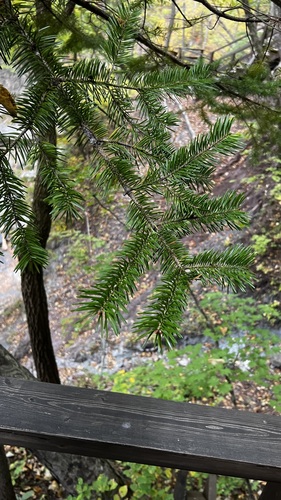
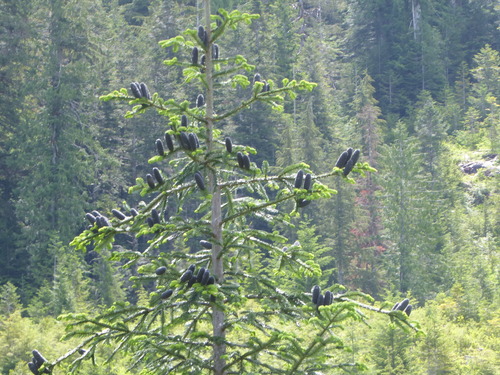
Description: This species is a large evergreen conifer. Typically it grows 30–50 m (98–164 ft) tall, with exceptional individuals reaching up to 72 m (236 ft). It reaches a trunk diameter of up to 1.2 m (4 ft), with exceptional individuals reaching up to 2.3 m (7+1⁄2 ft). Young trees have light grey, thin bark covered in resin blisters; bark of older trees darkens and develops scales and furrows. Leaves are needle-like and flattened, measuring 1–4.5 cm (3⁄8–1+3⁄4 in) long, 2 mm (1⁄16 in) wide, and 0.5 mm (1⁄32 in) thick. They are dark green on the upper surface, with two white stomatal bands on the lower surface, and have a slightly notched tip. Leaves are arranged spirally on shoots, but each leaf base is variably twisted so the leaves lie flat to either side of and above the shoot, with no leaves below the shoot. Shoots are orange-red and covered in dense velvety pubescence. Cones are 8–17 cm (3–6+1⁄2 in) long and 4–6 cm (1+1⁄2–2+1⁄4 in) broad, and dark purple before maturity; the scale bracts are short and hidden inside the closed cone. The brownish, winged seeds are 3.5 mm (1⁄8 in) long, and are released when cones disintegrate at maturity around 6–7 months after pollination. This tree can live for over 400 years; the oldest known sampled individual, located on Mount Cain, was approximately 920 years old when sampled. Distribution and ecology: Abies amabilis is native to the Pacific Northwest of North America, occurring in the Pacific Coast Ranges and Cascade Range from extreme southeast Alaska, through western British Columbia, Washington and Oregon, to extreme northwest California. It grows from sea level to 1,000 m (3,300 ft) in the northern part of its range, and from 610–2,000 m (2,000–6,560 ft) in the southern part of its range. Populations on the east slope of the Cascades are restricted to elevations above 1,000 m (3,300 ft) in Washington and above 1,160 m (3,810 ft) in Oregon. It always grows in temperate rainforests that have relatively high precipitation and cool, humid summers. It grows in dense stands, and thrives in shade and snow. Common associated tree species are western hemlock in the northern part of its range, Douglas-fir in central areas, and California buckeye in the extreme southern end of its range. Western hemlock is equally shade tolerant, but Pacific silver fir saplings are more resilient to ground obstacles. While its thin bark makes the species susceptible to fire, slow-growing Pacific silver fir saplings outcompete less shade-tolerant species. It survives well at high elevation, but eventually dies from root or heart rot, alongside other diseases and insect pests such as Adelges piceae. On northeastern Vancouver Island, Pacific silver fir grows alongside western hemlock in dense forests with sparse understory vegetation. Another forest type in the area is dominated by western redcedar and western hemlock, has a more open canopy, and has an understory primarily composed of salal (Gaultheria shallon). The two forest types occur in areas with very similar environmental conditions, and are separated by sharp boundaries often less than 10 m (33 ft) wide. Western redcedar recruitment is nearly absent in the western hemlock–Pacific silver fir forest type, and there is no evidence of a transitional stage between the two forest types. It has been hypothesized that once established, these forest types are self-sustaining and unlikely to change unless a major disturbance occurs. Uses: Indigenous Nations including the Nuxalk, Haisla, and Kitasoo used A. amabilis for medicinal purposes. Ethnobotanist Daniel Moerman records that the Nuxalk people mixed mountain goat tallow with liquid pitch from the species to treat sore throats, while an infusion of bark was used to address stomach issues. Beyond medicinal uses, the Ditidaht people sometimes chewed hardened pitch from the plant for pleasure. The species has attractive fragrant foliage, valued long before European settlers arrived in its native range: the Ditidaht brought branches into their homes as an air freshener, while the Nlakaʼpamux people boiled branches to make a plant-based hair perfume. The wood of A. amabilis is soft and not very strong, so European settlers generally used it for papermaking, packing crates, and other low-cost construction work. Its lumber is often mixed with that of western hemlock. Seeds of A. amabilis were not introduced to England for cultivation until the 19th century; David Douglas first transported seeds abroad in 1825. Today, the tree is sometimes planted as an ornamental in large parks, though its requirement for cool, humid summers limits areas where it grows well. Successful growth outside its native range is restricted to areas such as western Scotland and southern New Zealand. It is also sometimes used for Christmas decoration, including as Christmas trees.