About Xyrichtys novacula (Linnaeus, 1758)
Size
The pearly razorfish, Xyrichtys novacula, can reach a total length of 38 cm (15 in), though most individuals do not grow longer than 20 cm (7.9 in).
Body Shape
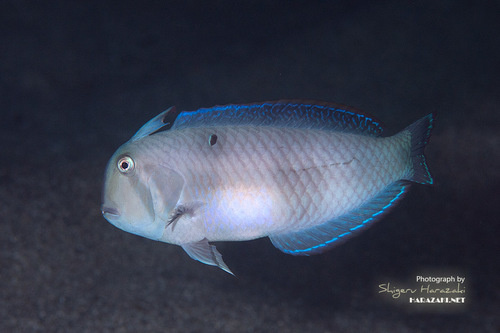
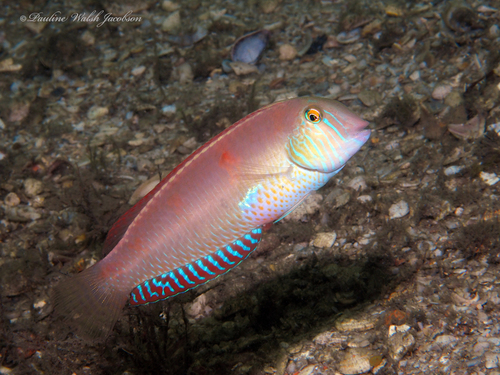
Its body is elongated and very laterally compressed, with a flattened head that has a steep profile and sharp teeth.
Fin Structure
A long dorsal fin runs along most of its back; this species has 9 dorsal spines, 12 soft dorsal rays, 3 anal spines, and 12 soft anal rays.
Body Coloration
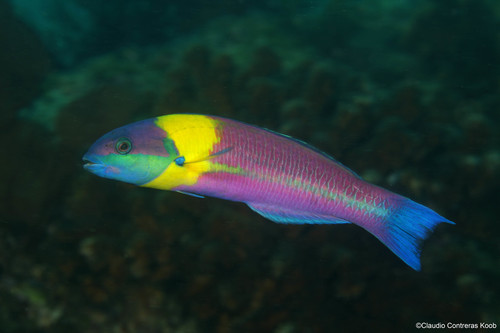
Its base body color is yellow-orange or reddish-pink, darker on the back and lighter on the belly, and is sometimes marked with green and gray stripes.
Head and Abdomen Features
The head has bluish vertical lines, and the abdomen bears scales with brisk reflexes.
Capture Defense Behavior
When captured, this fish is known to rotate its mouth and sharp protruding teeth more than 90 degrees to either side relative to its body, in an attempt to escape being held.
Distribution Range
The pearly razorfish is widespread across the subtropical and tropical Atlantic Ocean, and is also found in the Mediterranean Sea.
Typical Habitat
It lives in clear, shallow littoral areas with sandy or muddy bottoms, at depths between 1 and 20 meters.
Winter Depth Range
During winter, it migrates to deeper water, reaching depths of 90 to 150 meters.