About Pseudodax moluccanus (Valenciennes, 1840)
Adult Coloration
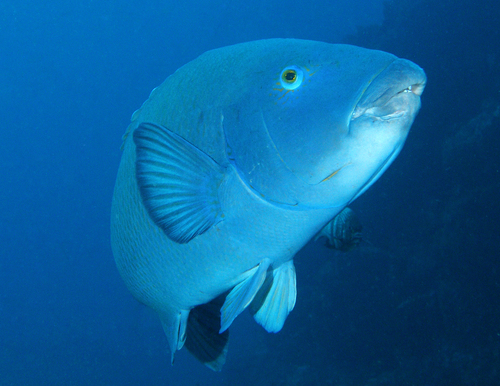
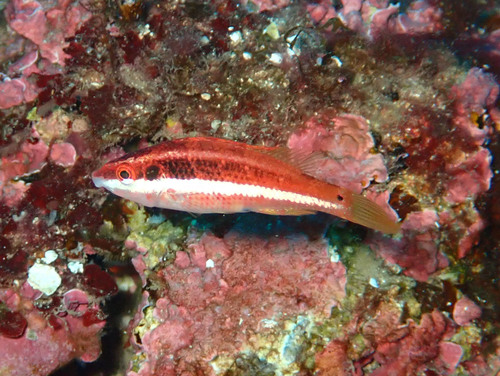
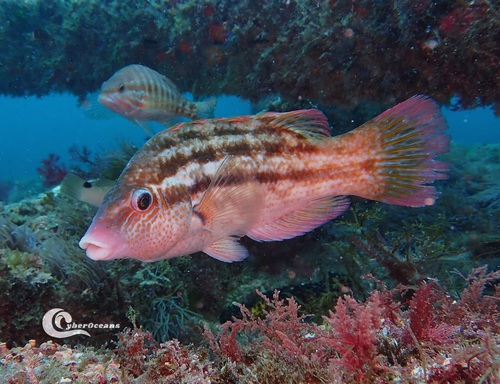
Pseudodax moluccanus (Valenciennes, 1840), commonly called the chiseltooth wrasse, has a greyish to reddish-brown base body color, with a dark streak or spot on each individual body scale. It has a yellow upper lip, with a blue streak running above the lip, and blue teeth. Its caudal fin is black, with a blue outer margin.
Juvenile and Subadult Coloration
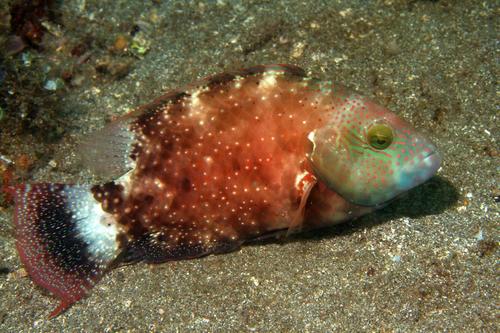
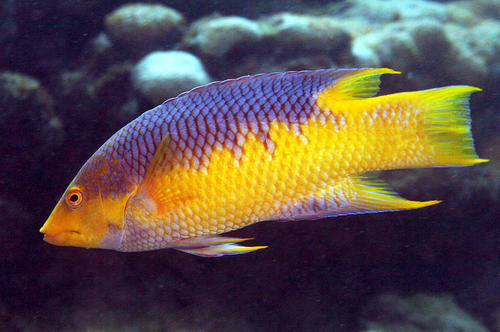
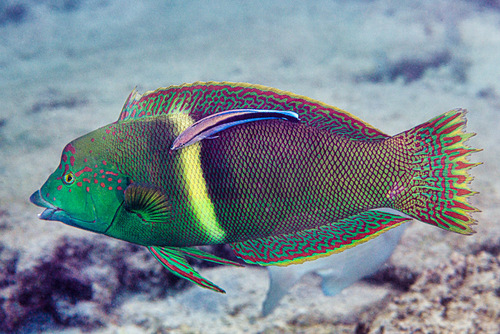
Juvenile chiseltooth wrasses are pale blue with a wide stripe along their flanks, while subadults show a distinct yellow band at the base of the tail. Juveniles of this species strongly resemble cleaner wrasses from the genus Labroides, and also behave as cleaner fish.
Fin Structure
The species has 11 spines and 12 rays in its dorsal fin, and its anal fin has 3 spines and 14 soft rays.
Maximum Size
The maximum total length this species can reach is 30 centimetres (12 in).
Distribution Range
The chiseltooth wrasse has a wide distribution across the Indo-Pacific region. Its range extends from the western Indian Ocean, starting from the Red Sea and stretching south to South Africa, eastwards to the Tuamotus, north to Japan, and south to Lord Howe Island, Australia.
Habitat and Depth
This wrasse inhabits clear channels and the seaward edges of reefs, found at depths between 3 and 60 metres (10 to 200 ft). Juveniles are frequently found along drop-offs at depths greater than 18 metres (60 ft).
Microhabitat Preference
Adult fish are found near caves, while juveniles often live inside caves.
Adult Behavior and Diet
Adults are solitary, and feed on a diet of algae and small invertebrates.
Juvenile Behavior
Juveniles have been documented acting as cleaner fish.
Taxonomic Relationships
Due to the tooth arrangement in its mouth, this species is considered closely related to parrotfishes of the family Scaridae, though its behavior is more similar to fish in the genus Anampses.