About Vitex lucens Kirk
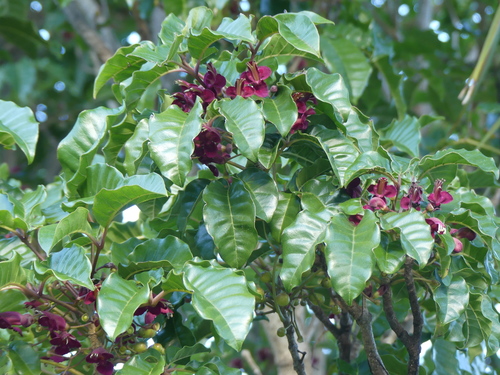
Pūriri (Vitex lucens Kirk) is a tree that can grow up to 20 metres (66 feet) tall, with a trunk that commonly reaches 1.5 m (4 ft 11 in) in diameter and is often thicker. It develops a broad spreading crown. Its thin bark is typically smooth and light brown, though it can also be very flaky. In the past, pūriri was actively and selectively logged to produce timber for a wide range of uses. Loggers only felled the best-quality trees, leaving the gnarled pūriri that is often seen on farm paddocks today. This pattern of logging has created the false impression that pūriri cannot grow straight, but early historical reports describe naturally clear boles measuring 15 to 30 feet (4.5 to 9 m) long, and a small number of these straight-trunked trees still survive. A prominent example of a well-shaped pūriri grows behind Ruapekapeka Pā in Northland. This species is endemic to New Zealand, and it is the only member of the genus Vitex that occurs in the country. It grows in the upper half of the North Island, ranging from North Cape to the Waikato and Upper Thames. Small populations extend further south, reaching as far as Māhia Peninsula (39°10′S) on the east coast and Cape Egmont (39°27′S) on the west coast, and the species is rare inland south of latitude 37. It grows from sea level up to 800 m (2,600 ft) above sea level. Pūriri is typically associated with fertile or volcanic soils, and early European settlers often sought out areas with dense pūriri growth and burned them to create productive farmland.