About Vigna hosei (Craib) Backer
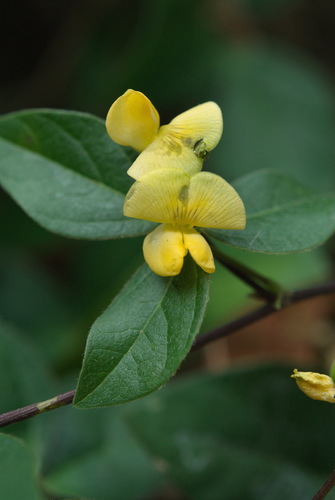
Vigna hosei (Craib) Backer is a twining or creeping legume that often forms a thick ground cover. Its leaflets range from ovate to elliptic, covered with thin, long hairs on both sides. The terminal leaflet measures 3–7.5 cm (1.2–3.0 in) long by 2–5 cm (0.79–1.97 in) wide. The plant produces yellow flowers that measure 7–8 mm (0.28–0.31 in) by 7–10 mm (0.28–0.39 in); its pedicel is 1–3 mm (0.039–0.118 in) long and expands as the pod matures. Bracteoles are 1 cm (0.39 in) long with a single nerve, and the calyx is slightly covered with fine hairs. In addition to normal flowers and pods, Vigna hosei produces additional flowers that stay concealed under a thick carpet of the plant’s own half-decayed leaves. These concealed flowers grow on a 2.5–6 cm (0.98–2.36 in) long pale stalk. When ripe, these concealed structures are very yellow, finely and quite densely covered in fine hairs, and typically hold one to two seeds. They are generally 1–1.5 cm (0.39–0.59 in) long. The mature pods from normal flowers are 1–2 cm (0.39–0.79 in) long, black, and usually contain one to three seeds. Vigna hosei is native to Taiwan, Indonesia, and Malaysia in tropical Southeast Asia. It is widely cultivated and has become naturalized in tropical Africa (Kenya, Tanzania, Rwanda, Mozambique, and Madagascar), Australia, the U.S. states of Florida and Hawaii, and the Caribbean. It often forms thick ground cover, and can be found growing in grass along roadsides, in disturbed habitats or wastelands, on damp ground, and on sandy loam. In Africa, it occurs from 20–200 m (66–656 ft) above sea level; in Southeast Asia it grows anywhere below 500 m (1,600 ft) above sea level. This species needs 2,500 mm (98 in) of annual rainfall. Due to its shallow root system, it can withstand flooding but cannot tolerate drought. One of its most notable traits is that it persists well under shade, though full sunlight is needed for good seed production. It can grow in a wide range of soils but prefers acidic soils with a pH of 4.9 or lower. When grown as a cover crop, Vigna hosei is susceptible to the fungal disease caused by Rhizoctonia solani, which leads to wilting of large patches of leaves; wet weather encourages the spread of this disease. Vigna hosei is also among the many plant species that can be infected by cucumber mosaic virus. Vigna hosei is used as a green manure and ground cover crop in young tree plantations, as well as in rubber, tea, and coconut plantations. Its seedlings grow vigorously, and young plants quickly suppress weed growth, forming a thick growth mat with dense leaf litter that protects soil from erosion and blocks weeds from establishing. Its ability to fix atmospheric nitrogen enriches the soil and promotes the growth of plantation trees. Because it persists well under shade, it can be added to mixtures of leguminous cover crops for young plantation trees. It is also used as animal forage and is tolerant of heavy grazing.