About Lupinus sericeus Pursh
Scientific Name and Common Names
Lupinus sericeus Pursh, a flowering plant species in the legume family, is commonly known as silky lupine or Pursh's silky lupine.
Native Distribution
It is native to western North America, ranging from British Columbia south to Arizona, and east to Alberta and Colorado.
Growth Form and Root System
This is a perennial herb that grows erect stems from a woody caudex connected to a deep root system.
Stem Characteristics
Stems can reach up to 50 centimeters (20 inches) tall, and they may or may not branch. The stems are covered in silvery or reddish hairs.
Leaf Structure
Each leaf holds up to 9 lance-shaped leaflets, with each leaflet reaching up to 6 centimeters (2.4 inches) long. The leaflets are coated in fine, silk-like hairs.
Inflorescence and Flower Color
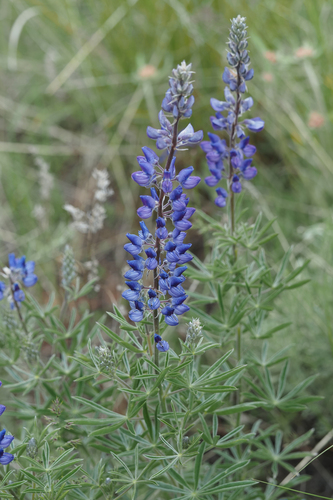
The inflorescence is a raceme holding many flowers, which are most often purple or blue, but can occasionally be white or yellowish. The back of the banner petal is covered in hairs.
Fruit and Seed Characteristics
The fruit is a hairy legume pod up to 3 centimeters (1.2 inches) long, and holds up to 7 seeds.
Habitat Types
This plant grows in a wide variety of habitat types, including forests, woodlands, chaparral, shrubsteppe, sagebrush, and grasslands.
Site Preferences
It often occurs on dry, rocky slopes, and grows best in open, unshaded sites.
Elevation Range and Disturbance Adaptation
It can be found at both low and high elevations, growing up to 3,000 meters (9,800 feet) or higher, and it frequently colonizes recently burned sites.
Associated Plant Species
Plant species commonly associated with Lupinus sericeus include Gambel oak (Quercus gambelii), common snowberry (Symphoricarpos albus), ninebark (Physocarpus malvaceus), serviceberry (Amelanchier spp.), mountain-mahogany (Cercocarpus spp.), arrowleaf balsamroot (Balsamorhiza sagittata), western yarrow (Achillea millefolium), heartleaf arnica (Arnica cordifolia), bluebunch wheatgrass (Pseudoroegneria spicata), Sandberg bluegrass (Poa secunda), fescues (Festuca idahoensis and F. scabrella), prairie junegrass (Koeleria cristata), and sedges (Carex spp.).
Toxicity to Livestock
Like many other lupine species, this plant is highly toxic to sheep, and less toxic to cattle and horses. It contains teratogenic chemical compounds that can cause birth defects in calves if a pregnant cow consumes the plant during the early stage of gestation.
Toxicity Source
Its toxicity comes from concentrated quinolizidine alkaloids.
Toxicity to Wild Herbivores
It does not appear to be toxic to wild animals such as white-tailed deer, which often eat it. Bighorn sheep feed on it in Montana, and Columbia ground squirrels eat its leaves and flowers. Many other small mammals and birds also consume parts of this plant.