About Vicia grandiflora Scop.
Taxonomic Classification
Vicia grandiflora Scop. is a relatively common annual legume.
Growth Habit
It is a usually upright, sprawling hirsute vining plant, growing between 30 and 60 centimetres tall.
Leaf Structure
It produces alternate, petiolate, pinnately compound leaves, with 6 to 14 leaflets total.
Subspecies Leaflet Variation
Leaflet shape varies by subspecies: leaflets are round to obovate in Vicia grandiflora subsp. grandiflora, and linear to oblanceolate, sometimes narrowly cordate, in Vicia grandiflora subsp. sordida.
Leaf and Leaflet Features
Each individual leaflet ends in a short, sharp point, and each full leaf ends in a three-part tendril.
Pollination and Flowering Period
This species is pollinated by insects, and flowers in spring, typically from April to June.
Flower Form and Color
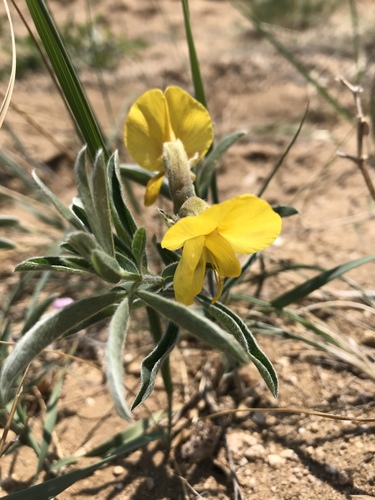
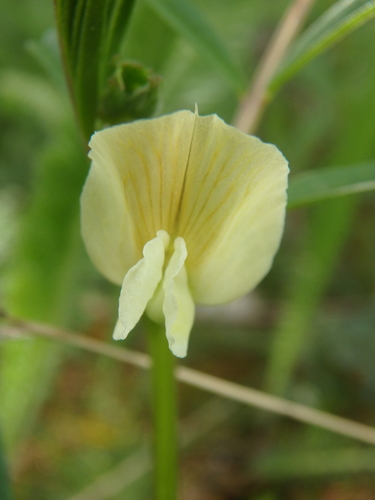
Its flowers are the typical bilaterally symmetrical papilionaceous form made up of a banner, keel and wing, with bright yellow petals; over time, flowers may fade from their original bright yellow to a pale lavender shade.
Flower Size and Inflorescence
Individual flowers measure 2 to 3 centimetres across, and several flowers grow together to form an inflorescence.
Inflorescence Attachment
Inflorescences may be either sessile or borne on short petioles.
Sepal Characteristics
The species' sepals are fused into a long calyx tube that is sometimes hairy, ending in pointed calyx teeth.
Fruit Size
Its dry fruit is a legume pod measuring 3 to 5 centimetres.
Fruit Development and Dispersal
The pod typically darkens as it ages, and splits open when ripe to release its seeds.
Similar Species
Vicia grandiflora can be confused with similar species, including the vetches Vicia lutea and Vicia pannonia, and the vetchling Lathyrus pratensis.
Native Distribution
Vicia grandiflora is native to Europe and parts of Asia, where it has been recorded in Armenia, Austria, Azerbaijan, Belgium, Bosnia & Herzegovina, Bulgaria, Croatia, Czech Republic, France, Georgia, Germany, Greece, Hungary, Italy, Luxembourg, Netherlands, Norway, Poland, Slovakia, Slovenia, Sweden, Switzerland, Syria, Tajikistan, Turkey, Ukraine, and the United Kingdom.
Introduction History
It was later introduced to North America, likely as forage for grazing animals.
Introduced Range and Status
In North America, it is mostly restricted to eastern and southeastern states of the United States, and it is considered an invasive species in some areas.
Habitat Range
Vicia grandiflora grows in a wide range of different habitats, including anthropologically modified urban areas.
Specific Habitat Types
It can be found on meadows, in open forests, in fields and gardens, and in ruderal landscapes.
Elevation Range
It rarely occurs in mountains, only growing at elevations up to 1,800 metres.
Habitat Preferences
It is a habitat generalist that prefers warm, sunny growing sites.
Conservation Status
It is listed as Least Concern (LC) on the IUCN Red List, and its overall population is rated as stable.