About Veronica scutellata L.
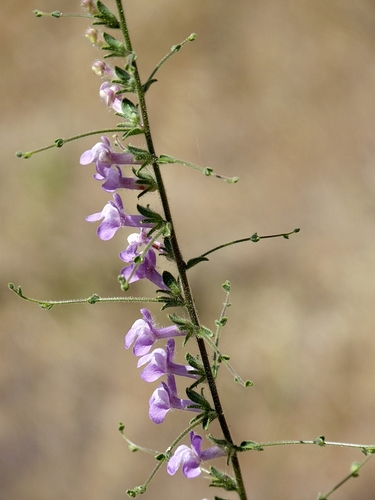
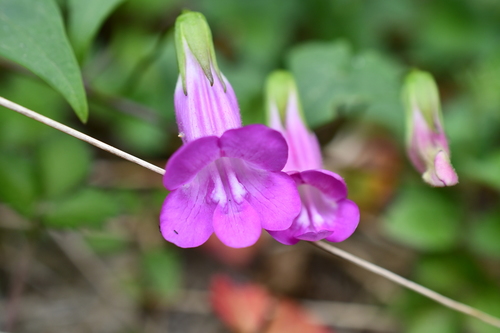
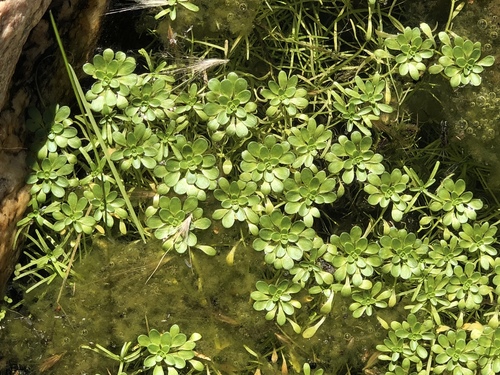
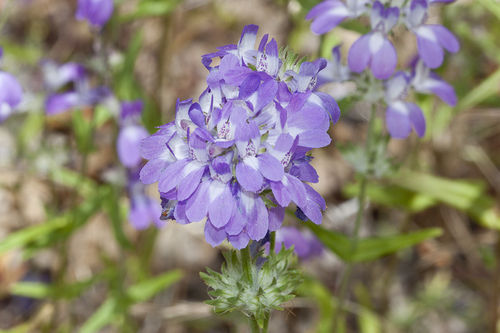
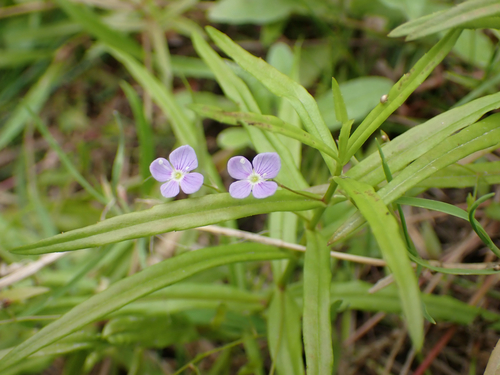
Veronica scutellata L. is a non-woody herbaceous perennial speedwell. It grows creeping stems that root at their nodes, then ascend to flower, reaching up to 60 cm (24 in) in length, and uses other vegetation as a structural scaffold. Its paired leaves alternate in orientation; they are very narrow, pointed, stalkless, and somewhat rigid, often carry a yellowed or reddened hue, have obscure or no teeth, and curl under along the edges. When young, the plant holds its leaves vertically to push through surrounding vegetation, and later opens the leaves sideways to anchor its position. Alternating floral spikes grow from the stem at the base of the leaf stalks, each holding a sparse arrangement of several flowers, with individual flowers borne on long thin stalks. The flowers are small, measuring 3–7 mm (0.12–0.28 in) across, and are typically pale lilac, pale blue or whitish, though sometimes they are strongly coloured, with noticeable accentuated veins. When mature, the flowers form flat capsules 3–5 mm long that are deeply divided at the top. While the typical variety (var. scutellata) is mostly hairless, some forms classified as var. villosa are densely hairy, usually with a mixture of glandular and non-glandular hairs, and this hairier form occurs especially in drier habitats. Photographic examples of Veronica scutellata L. can be viewed on iNaturalist. This species is native to Europe (where it is rare near the Mediterranean), North Asia, most of North America, and Algeria, and there is no record of it being introduced to any other country. It grows in marshes, shores, water banks, and a wide range of other wet locations, and prefers particularly acidic conditions. In North America, its altitude range is 0–1800 (2400) m, and in Turkey it is found in the northern part of the country at 0–500 m altitude.