About Veronica persica Poir.
Taxonomic Identity and Reproduction
Veronica persica Poir. is an annual plant that reproduces by seed.
Cotyledon Morphology
Its cotyledons are triangular with truncated bases.
Leaf Shape and Size
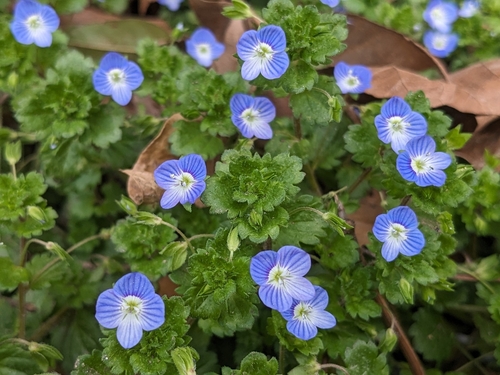
Its short-stalked leaves are broadly ovate with coarsely serrated margins, and grow 1 to 2 cm (0.4 to 0.8 in) long.
Leaf Arrangement
Leaves are arranged in opposite pairs on the lower stem, and in an alternate pattern on upper stem sections.
Stem Structure
This species has weak stems that form a dense, prostrate groundcover, with stem tips that often grow upright.
Flower Color and Size
Flowers are roughly 1 cm (0.4 in) wide, sky-blue with dark stripes and white centers.
Flower Symmetry
They are zygomorphic, meaning they have only one vertical plane of symmetry.
Flower Positioning
Flowers grow solitary on long, slender, hairy stalks that emerge from leaf axils.
Seed Characteristics
Seeds are transversely rugose, measure 1 to 2 mm (0.04 to 0.08 in) long, with 5 to 10 seeds per fruit locule.
Distinguishing Morphological Traits
The fruit lobes of Veronica persica diverge widely to form a spreading 'V', solitary flowers emerge from the stem with leaf stalks, and flower stalks are regularly much longer than the leaves.
Similar Species Comparisons
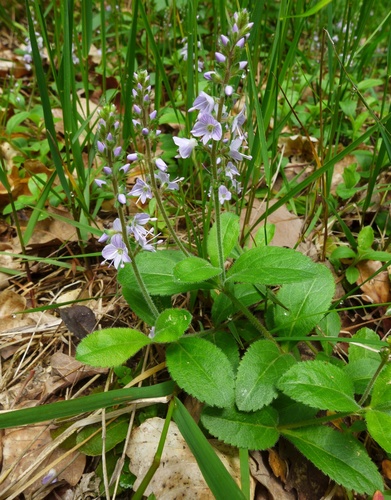
This sets it apart from several similar species: Veronica polita and Veronica agrestis have parallel fruit lobes and flower stalks shorter than or equal to leaf length; Veronica crista-galli has smaller flowers and fruits than its calyx, and its calyx is made of two bilobed parts instead of four unlobed parts; Veronica filiformis has small round leaves that are smaller than or equal in size to its flowers; Veronica chamaedrys and Veronica montana do not produce solitary flowers, instead bearing flowers in short, leafless spikes; Veronica hederifolia has small flowers and a different leaf lobe shape.
Habitat Locations
This plant grows in fields and lawns.
Preferred Growth Conditions
It prefers moist conditions and grows well in loamy soil.
Horticultural Status
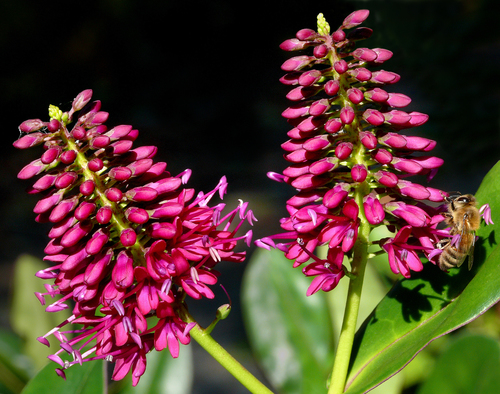
While many other species in the Veronica genus are used in gardens (including V. exalta, V. incana, V. gentianoides, V. longifolia, V. perfoliata, and V. spicata), Veronica persica is generally considered a weed and has no known horticultural uses.
Historical Herbal Use
In herbal medicine, Afghani herbalist Mahomet Allum used this plant to treat patients with heart trouble in Adelaide, Australia, in the mid-20th century.
Medicinal Applications
It has also been used to treat snakebite, hemorrhaging, rheumatoid arthritis, and asthma, and used as an expectorant.