About Veronica cymbalaria Bodard
Species Identity and Growth Habit
Veronica cymbalaria Bodard is a sprawling annual speedwell with white flowers. Under suitable conditions, it can cover entire patches of ground.
Morphological Comparison to Related Species
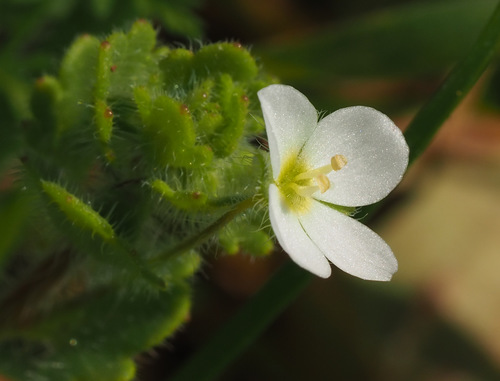
It resembles Veronica hederifolia (ivy-leaved speedwell), but differs by having white flowers 6 to 12 mm in diameter and more numerous leaf lobes, with 5 to 9 lobes per leaf.
Flower and Fruit Morphology
The sepals surrounding its flowers and fruit have broad lobes, and the fruit itself has a shallow indentation at its top.
Hairiness Variation
Plants are usually lightly hairy, but individuals may also be very hairy or completely hairless.
Photographic Resource
Photographic examples of this species can be viewed on iNaturalist.
Native Distribution Range
This species is native to Mediterranean-region countries and areas slightly beyond this range: its native distribution includes Albania, Algeria, the Balearic Islands, Bulgaria, Corsica, Cyprus, the East Aegean Islands, France, Greece, Iran, Iraq, Israel, Italy, Crete, Crimea, Lebanon, Syria, Libya, Morocco, Palestine, Portugal, Sardinia, Saudi Arabia, Sicily, Spain, Tunisia, Turkey, and the countries of the former Yugoslavia.
Introduced Distribution Range
It has been introduced to Belgium, central Chile, Great Britain, Louisiana (United States), the Netherlands, and the North Island of New Zealand.
European Habitat
In Europe, it grows in cultivated ground and other dry, open habitats.
Turkish Habitat and Elevation Range
In Turkey, it can be found in maquis, open Pinus forests, rocky slopes, banks, dunes, walls, ruins, waste places, and roadsides, at elevations between 0 and 1200 meters.