About Antirrhinum majus L.
Species and Growth Form
Antirrhinum majus L. is an herbaceous perennial plant that grows 0.5–1 m tall, and rarely reaches up to 2 m.
Upper Stem and Leaf Arrangement
Its leaves are spirally arranged, broadly lanceolate, 1–7 cm long and 2–2.5 cm broad. Upper stems are glandular and round in cross-section, sometimes becoming woody up to the middle section.
Lower Stem Leaf Characteristics
Lower stem leaves are opposite, simple, and range from elliptic, ovate, or broadly lanceolate to sometimes linear, and they are usually gray-green in color. Leaflets are absent.
Basic Flower Spike Structure
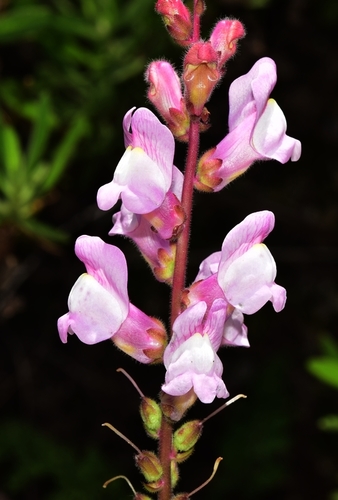
Flowers are borne on a tall spike; each flower is 3.5–4.5 cm long, zygomorphic, with two 'lips' that close off the corolla tube, which has a three-lobed lower division and is purple-red, reaching almost 5 cm in total length.
Wild Flower Coloration
Wild plants naturally have pink to purple flowers, often with yellow lips.
Inflorescence Features
Most inflorescences hold 8 to 30 short-stalked flowers, and the inflorescence axis is covered in glandular hairs.
Corolla Size and Color Range
The corolla measures 25 to 45 millimeters long, rarely up to 70 millimeters, and comes in a range of colors including red, pink, orange, yellow, and white.
Corolla Morphology
The opening of the corolla is closed by a protrusion on the lower lip, a feature called 'masked', and the corolla base is everted and swollen. Each flower has a whorl of four stamens.
Pollination
This species is pollinated by bumblebees, which are strong enough to gently and briefly open the flowers to enter and exit easily while collecting pollen.
Calyx Structure
The calyx of a snapdragon grows up to 8 mm long, with equal-length oblong to obovate sepals.
Ovary Position
The ovary is hypogynous, meaning it is superior in position.
Fruit and Seeds
The fruit is an ovoid capsule 10–14 mm in diameter shaped like a skull, containing numerous small seeds.
Native Range
Its native range extends from south-central France and the eastern Pyrenees to north-eastern Spain and the Balearic Islands.
Wild Habitat
Wild populations most often grow in rock crevices and on stone walls.
Current Global Distribution
Today, the species is found cultivated or naturalized on every continent except Antarctica.
Pests and Diseases
Antirrhinum majus may be affected by a number of different pests and diseases.
Temperature Tolerance and Optimum Growth
This species can tolerate a moderate amount of frost and higher temperatures, but grows best at 17–25 °C (63–77 °F). Nighttime temperatures around 15–17 °C (59–63 °F) encourage growth in both the apical meristem and stem.
Propagation from Seed
The species grows well from seed, and flowers quickly just 3 to 4 months after sowing.
Vegetative Propagation
It can also be propagated from cuttings.
Cultivation Growth Cycle
Though it is naturally a perennial, it is very often cultivated as a biennial or annual plant, particularly in colder regions where it cannot survive winter.
Cultivar Variety
Numerous cultivars are available, including plants with lavender, orange, pink, yellow, or white flowers, as well as cultivars that produce peloric flowers, where the normal tall flowering spike is topped by a single large, symmetrical flower.
Horticultural Awards
The cultivars 'Floral Showers Deep Bronze' and 'Montego Pink' have received the Royal Horticultural Society's Award of Garden Merit.
Trailing Variety Taxonomy
The trailing (creeping) variety of this species is often referred to as A. majus pendula, with synonyms A. pendula and A. repens.
Naturalized Range Outside Native Habitat
This plant often escapes from cultivation, and widespread naturalized populations occur in Europe north of its native range, as well as in other temperate regions around the world.
Common Names
Historical common names for Antirrhinum majus include: great snapdragon, lion's-mouth, rabbit's mouth, bonny rabbits, calf-snout, toad's mouth, bulldogs, and lion's-snap.