About Veronica arvensis L.
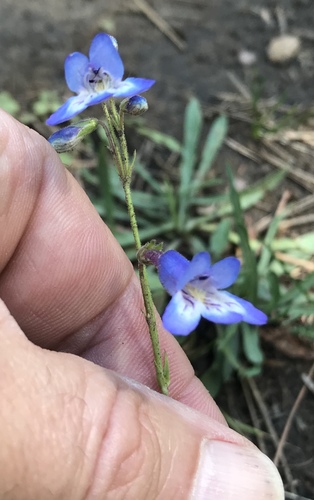
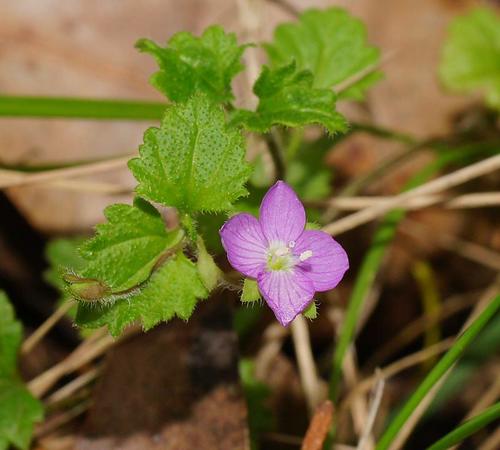
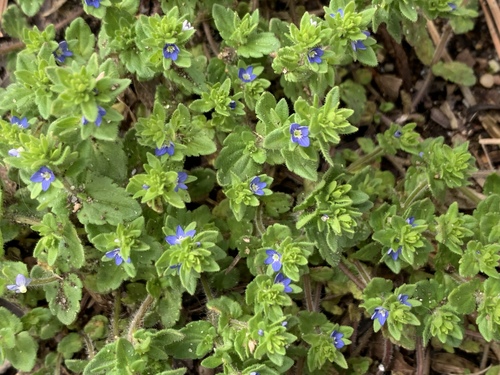
Veronica arvensis L. is an annual herb that grows from a taproot. It is covered in hairs, and ranges in growth form from erect to nearly recumbent, reaching 9 to 40 centimetres (3.5 to 15.7 in) in height. Its leaves are arranged in opposite pairs around the stem; lower leaves have short petioles, while upper leaves are sessile. Each leaf is 1.5 to 2.5 centimetres (0.59 to 0.98 in) long, shaped ovate or triangular with a truncated or slightly cordate base, and has coarse teeth. The flowers are borne in a raceme that is initially compact and elongates as it ages. The flowers are pale blue to blue-violet, 2 to 3 mm in diameter, four-lobed with a narrow lowest lobe. Flower stalks measure 0.5 to 2 millimetres (0.020 to 0.079 in) and are shorter than the bracts. The fruit capsules are heart-shaped and shorter than the sepal-teeth. This species flowers from April to October. Photographic examples of Veronica arvensis L. can be viewed on iNaturalist. Compared to similar species, V. arvensis has incised rather than deeply lobed stem leaves. The similar species Veronica verna has well-lobed stem leaves, but when it produces only a small number of leaves, the whole plant can resemble V. arvensis. Veronica arvensis L. is native to Africa, Asia, and Europe. It is classified as a medicinal plant. In ethnobotany, this herb has alterative, antiscorbutic, and diuretic properties. It has been used to treat scurvy, blood impurities, and other related conditions. It is also used as a remedy for scrofulous affections, especially those affecting the skin. When bruised, it can be applied externally to help heal burns and ulcers.