About Penstemon griffinii A.Nelson
Scientific Name and Basic Life Form
Griffin's penstemon, scientifically named Penstemon griffinii A.Nelson, is a relatively long-lived perennial herb for a penstemon. Its stems are somewhat woody at the base, growing straight upward to a height of 12 to 50 centimeters.
Stem Hairs and Surface
Near the base, stems have retrorse hairs that point backward, while glandular hairs are found further up, and stems are never covered in natural waxes. This species produces both basal leaves that grow from the base and cauline leaves that grow from the stems.
Leaf Texture and Hairiness
The leaves are not leathery, and may be either hairless or have hairs along the midvein. Basal leaves and lower stem leaves measure 13–55 millimeters by 4–12 millimeters, with a tapering base and a shape that is spatulate, oblanceolate, or elliptic.
Stem Leaf Arrangement
Stems usually bear two to five pairs of oppositely attached leaves, but occasionally have as many as six pairs. Upper leaves are narrow and grass-like, measuring 5–52 millimeters long by 0.3–5 millimeters wide.
Inflorescence and Flower Color
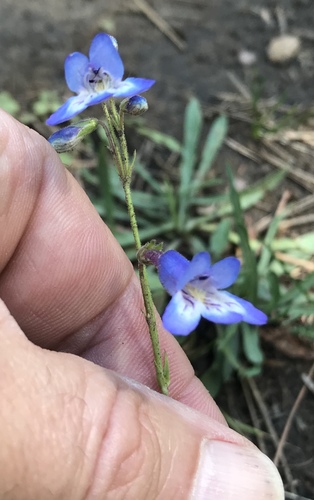
The slender inflorescence holds all blue to purple flowers pointing in a single direction. Flowers are arranged in one to five groups along the stem; each group usually has just one branched attachment point, but may have two, with one to three flowers per attachment point.
Flower Structure and Size
The flowers are quite narrow with a small opening and a white palate. They measure 17 to 25 millimeters, are covered in glandular hairs on the outside, have dense golden hairs on the lower surface of the floral tube, and two noticeable ridges at the bottom of the floral tube.
Staminode Characteristics
The staminode is 7 to 11 millimeters long, covered in dense golden hairs, and does not extend outside the floral tube. Flowering occurs from as early as June to as late as August.
Fruit Description
The fruit is a hairless capsule that measures 6–9 millimeters tall by 4–5 millimeters wide. Griffin's penstemon is native to the U.S. states of Colorado and New Mexico.
Colorado Distribution
According to the Flora of North America, it has a larger range in Colorado, where it grows in seven south-central counties extending from Park and Chaffee counties in the north southward to the Colorado state line. Its range in Colorado is largely concentrated in South Park and the San Luis Valley.
New Mexico Distribution
Across the border in northern New Mexico, Flora of North America reports it is only found in Rio Arriba and Taos counties, though the USDA Natural Resources Conservation Service plants database additionally records it in Santa Fe County. Within its range, it grows at elevations between 2,500 and 3,000 meters, or 8,200 and 9,800 feet.
Habitat Types
Its natural habitat includes mountain grasslands, open conifer forests, and rocky slopes. It is a somewhat rare plant in cultivation, with cultivation first starting around 2003, and its seeds are easy to germinate.