About Vermicella annulata (Gray, 1841)
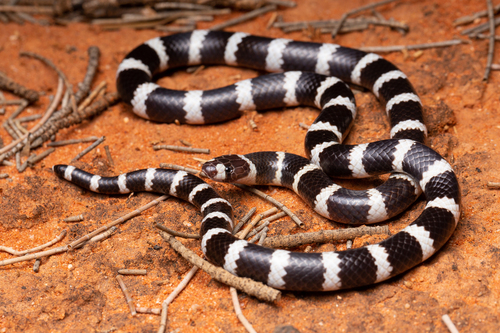
Vermicella annulata, commonly known as the bandy-bandy, is a smooth-scaled, glossy snake with a distinctive pattern of sharply contrasting black and white rings that continue all the way around its body.
Name Etymology
This unique banding pattern clearly distinguishes bandy-bandys from other Australian land snakes; the pattern gives the species both its common name and its scientific name, which comes from annul-, the diminutive form of the Latin word anus meaning "ring".
Tail Morphology
The bandy-bandy has a relatively short tail with fewer than 35 subcaudals and a blunt tip, a feature that sets it apart from other elapids.
Scale Characteristics
Its dorsal scales are arranged in 15 rows at midbody.
Size
The average total length, including the tail, is 50 to 60 cm (20 to 24 in), but size varies greatly between sexes.
General Habitat Range
Bandy-bandys occupy a wide variety of habitats, ranging from desert regions to wet rainforest.
Genus Distribution
For V. annulata specifically, its distribution spans across the east coast of Australia, while other Vermicella species are found in far northern Australia and the arid regions of western and central Australia.
Queensland Distribution
V. annulata occurs mainly in suburbs with woodland habitats, such as Mt Cotton, Mt Crosby, Kholo, Brisbane, and Lockyer Valley.
Common Habitat Areas
It is most common in areas of remnant habitat structure, such as the foothills of Mt Glorious and Brisbane Forest Park.
Additional Regional Records
It has also been recorded at Cannonvale in the Whitsundays region of North Queensland, in the Coffs Harbour region in late 2019, and north of Murwillumbah in the Far North Coast region of New South Wales in late 2021.
Southeast Queensland Habitats
In Southeast Queensland, it is found across a wide range of habitats and vegetation types, from coastal forest and woodland, to scrubland, mulga, and outback desert.
Wider Distribution
It is also found in central New South Wales (Dubbo/Parkes), Lower North Coast New South Wales (Pacific Palms/Hunter Valley), White Rock and Spring Mountain Conservation Park near Ipswich, Queensland, and the south-eastern part of South Australia.
Reproductive Strategy
The bandy-bandy is oviparous, meaning it produces offspring inside eggs that hatch after laying.
Female Reproductive Cycle
Females produce offspring seasonally, laying eggs in late summer (February – March) after undergoing vitellogenesis in October.
Elapid Reproductive Cycles
Both live-bearing and oviparous Australian elapid snakes follow a similar seasonal reproductive cycle.
Live-bearing Elapids
Live-bearing elapids undergo ovulation in October – December and give birth in February – April after a 14-week gestation period.
Oviparous Elapids
Oviparous elapids undergo ovulation at the same time (October – December), and their eggs are laid shortly after ovulation without a long gestation period.
Offspring Emergence Timing
Newly hatched young emerge at the same time that live-bearing snakes give birth (February – March).
Second Clutch Evidence
However, there is evidence that oviparous elapids may be able to produce a second clutch of eggs in late summer, with newly hatched offspring emerging around April.
Clutch Size
For V. annulata, the average clutch size is 7.7 offspring, and a single clutch can hold up to 13 offspring.
Sexual Dimorphism
Sexual dimorphism is visible in bandy-bandys, with females being much larger in size than males.
Snout-vent Length Differences
In one study, female V. annulata had a mean snout-vent length of 54.4 cm, compared to 39.2 cm for males.
Clutch Size Correlation
In many reptiles, clutch size depends on the size of the mother.
Fecundity Selection
The advantages linked to higher fecundity can create selective pressure for female snakes to grow larger, but the relationship between increased clutch size and maternal size, and the intensity of this selection, varies between species.
Female Size Driver
For the bandy-bandy, larger female size is thought to be caused by selective pressure on fecundity.
Male-Male Combat Trait
Male-male combat is a well-documented, common trait in many animals as a form of sexual selection, which creates selective pressure for males to grow larger.
Combat and Size Correlation
In an analysis of snakes, male size relative to female size was larger in snake species where male-male combat occurs.
Bandy-bandy Male Size
However, male-male combat is absent in bandy-bandys, so males are relatively small.