About Verbascum pulverulentum Vill.
Taxonomy and Common Name
Verbascum pulverulentum, commonly known as the hoary mullein, is a flowering plant species belonging to the family Scrophulariaceae.
Native Distribution
It is native to western, central, and southern Europe, with its native range extending north to England, where its main distribution occurs in East Anglia, and southern Wales.
Introduced Range
It has been introduced to Austria, Madeira, and Washington state in the United States.
Habitat and Preadaptation
This species is a specialist that grows on coastal shingle, which makes it preadapted to human-altered habitats including old quarries, gravel pits, road verges, railway embankments, and other similar disturbed stony areas.
Growth Form and Size
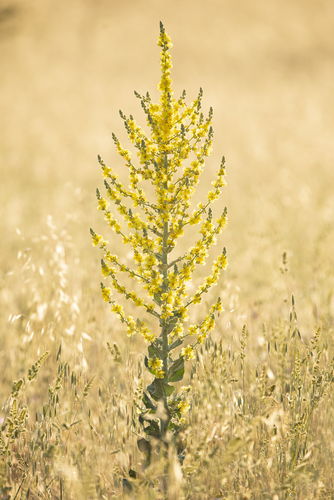
It is a stout biennial or monocarpic perennial herb that grows up to 1.5 meters tall.
Reproductive Cycle
It produces flowers and seeds only once, during its second year or a later year of growth.
Foliage Pubescence
Its stems and leaves are covered in a dense, woolly layer of pale grey to glaucous pubescence.
Flower Characteristics
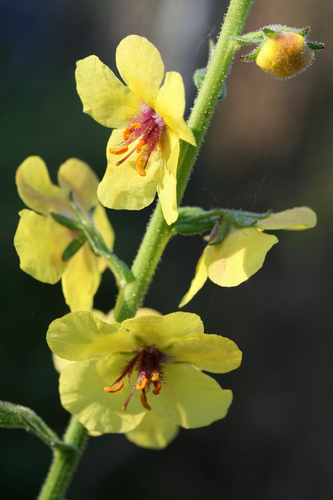
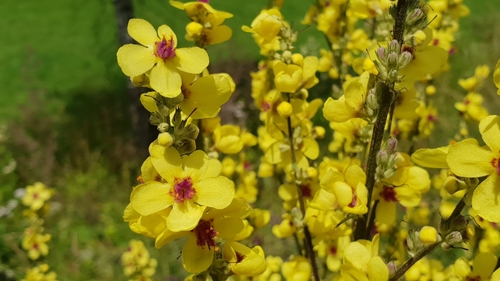
The flowers are yellow, 18 to 25 millimeters in diameter, and have 5 orange stamens; all of the stamen filaments are covered with dense white hairs.
Species Distinction Trait
This species can be most easily distinguished from the similar great mullein (V. thapsus) by this trait: all five of its stamens have dense white hairs on their filaments, while in V. thapsus the lower two of the five stamens are hairless or only thinly hairy.
Associated Fauna
Verbascum pulverulentum is the main food plant for the moth Nothris verbascella, commonly called the Norfolk snout.