About Ventenata dubia (Leers) Coss. & Durieu
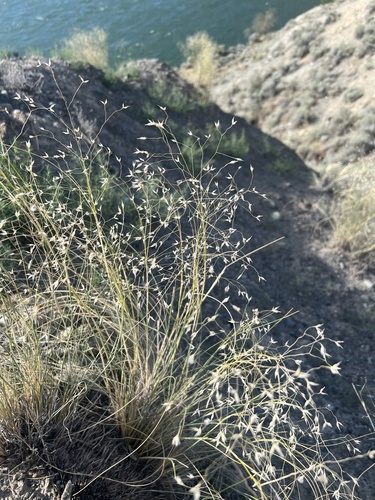
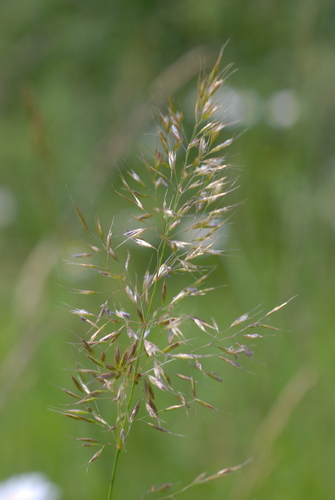
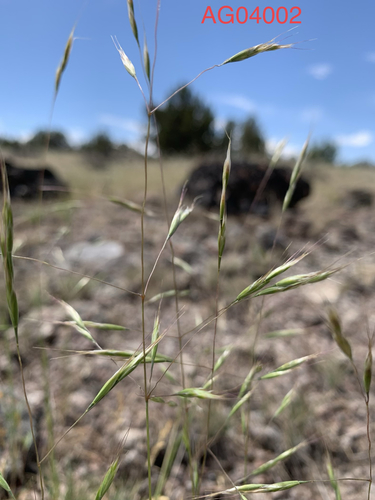
Ventenata dubia (Leers) Coss. & Durieu is a species of grass that has the common names North Africa grass and wiregrass. It is native to southern Europe, North Africa, and the Middle East. It has become widely recognized in North America, where it is an introduced species and a noxious weed that grows in cultivated and disturbed habitats. It is particularly problematic in the Pacific Northwest region of North America; it was first identified in Washington in 1952, in Idaho in 1957, and was found in Utah in 1996. It probably spreads when it becomes mixed into grass seed, which is then transported and planted unintentionally. This species is an annual grass that grows 15 to 70 centimeters tall, with thin, branching stems that are bare and wiry. The wiry texture of these stems makes the grass difficult to cut. Its inflorescence is an open panicle, with very slender, spreading branches that hold spikelets at their tips. Each spikelet is 1 to 1.5 centimeters long and has longitudinal, rib-like veins. The upper flower has a wavy awn that can reach up to 1.5 centimeters in length.