About Dryobates nuttallii (Gambel, 1843)
Wing and Tail Plumage
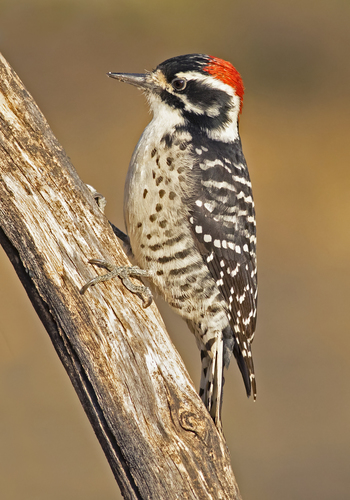
Nuttall's woodpecker (Dryobates nuttallii) has black and white striped wings, and tail feathers marked with white.
Underpart Coloration
Its underparts are mostly white with a small number of black spotted areas.
Head and Back Plumage
It has a black forehead with white streaks on the sides, and an unbarred black area on the upper back.
Sexual and Juvenile Crown Features
Adult males have a distinct red crown that females lack; this red feature is, however, present in juveniles of both sexes.
Juvenile Plumage
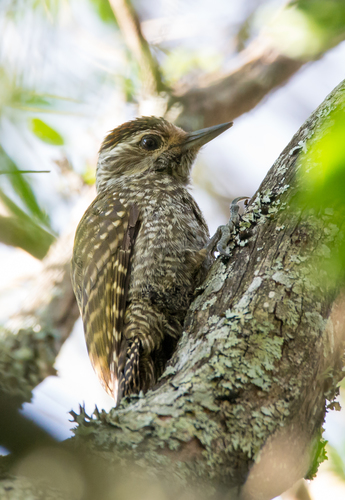
Juveniles are nearly identical to adults, except they typically have additional white streaks on their heads.
Climbing Adaptations
Like other woodpeckers, Nuttall's woodpeckers have zygodactyl feet, with two toes pointing forward and two pointing backward, paired with stiff tail feathers that let them hold a secure vertical position on tree trunks.
Weight and Length
Nuttall's woodpecker weighs between 30 and 45 g (1.1 to 1.6 oz), with a body length of 16 to 18 cm (6.3 to 7.1 in).
Wingspan and Size Classification
It is traditionally classified as a small to medium-sized bird, with a wingspan of approximately 38 to 43 cm.
Similar Species Distinction
It is often confused with Downy and Hairy woodpeckers, but horizontal stripes on its back distinguish it from these species.
Migratory Status and Core Range
Nuttall's woodpecker is a non-migratory species whose core range extends from northern California south to northwestern Baja California, Mexico.
Preferred Habitat
It prefers arid to mesic woodlands, and favors oak woodlands in particular.
Southern Range Habitat
In the southernmost parts of its range, where oak trees are less abundant, it also occurs in riparian sites and chaparral.
Elevation Range
Individuals are found from sea level up to 1,250 m (4,100 ft), and rarely up to 2,000 m (6,600 ft).
Permanent Range Boundaries
While vagrants have been recorded as far east as Central Wyoming, year-round sightings confirm the species' permanent range is restricted to the area from northern California (just below the Oregon border) south to Ensenada, Baja California.
General Range Limits
It generally occurs west of the deserts and the Sierra divide.
California Northern Range
Within California, the species ranges from Shasta and northwestern Lassen counties south through the foothills of eastern Trinity and southeastern Mendocino counties, to the Pacific Coast in Sonoma County and continues south to Los Angeles County.
California Southern Range
In southern California, its range extends along riparian habitats into deserts and along the lower slopes of mountains in eastern San Diego County.
Global Threat Status
Nuttall's woodpecker is not considered globally threatened, though its range is restricted to the California Endemic Bird Area.
Population Size and Density
It is fairly common in California, with a total global population estimated at over 100,000 individuals; in San Bernardino County, density is around 20 birds per square kilometer.
Population Trend
Surveys have found no obvious population trends.
Urban Adaptation
The species has also adapted to urban areas, and can be found nesting in street trees and using deadwood for food in suburban and human-made natural areas such as parks.
Extralimital Sighting
A trace sighting of these birds has been reported from Aberdeen, South Africa via an Instagram post.
Breeding Timing
Pair bonding for Nuttall's woodpecker happens between late January and March, with most egg-laying taking place in April and May.
Courtship Calls
When males and females meet, they exchange soft wheezing calls that are similar to, but less intense than, the rattle calls used for territorial defense.
Drumming Behavior
Starting in late January, both sexes, especially males, drum within their home ranges.
Clutch Size
Average clutch size is reported to be around 4.6 eggs, and the full clutch size ranges from three to six eggs.
Mating System and Parental Care
Nuttall's woodpeckers are socially monogamous and provide bi-parental care.
Nest Excavation
Males excavate new nest cavities each year in dead trees of species such as willow, oak, and alder.
Nest Height
Nest cavities are located from ground level up to around 18 meters (60 feet) above ground.
Nest Defense
The birds aggressively defend their nest sites from both predators and other coexisting species.
Incubation Routine
Males incubate the eggs at night, and females incubate during the day.
Incubation Period
The incubation period lasts up to 14 days.
Fledging Timeline
Fledglings leave the nest around 29 days after hatching, and parental care continues for 14 more days after fledging.
Post-Fledging Behavior
Once juveniles have fledged, adults become inactive and tend to live solitary lives after their association with the juveniles ends.